


Page 179 - Clinical Anatomy
P. 179
ECA3  7/18/06  6:44 PM  Page 164


                 164  The upper limb


                hypothenar eminence. Flexor carpi ulnaris is inserted into it and when this
                tendon is relaxed by flexing the wrist the pisiform can be moved a little
                from side to side. The hook of the hamate can be felt by deep palpation just
                distal to the pisiform. The scaphoid is felt at the base of the thenar eminence
                and also within the anatomical snuff-box, where there is characteristic ten-
                derness when this bone is fractured. In a thin subject, the pisiform and the
                tubercle of the scaphoid can be seen as bulges when the wrist is extended.


                Muscles and tendons
                The anterior fold of the axilla is formed by the pectoralis major, and its poste-
                rior fold by the teres major and latissimus dorsi. The digitations of serratus
                anterior can be seen in a muscular subject on the medial axillary wall.
                   In the upper arm the deltoid forms the smooth contour of the shoulder.
                The biceps and brachialis constitute the bulk of the anterior aspect of the arm,
                and the triceps its posterior aspect.
                   When the forearm is flexed against resistance, the brachioradialis pre-
                sents prominently along its radial border.
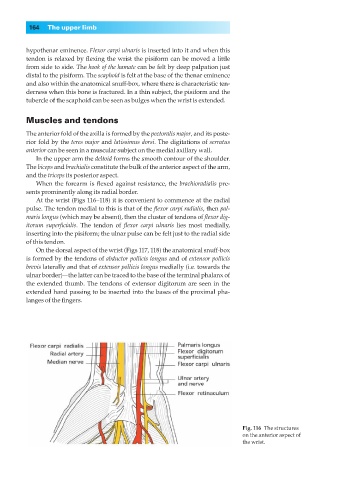
                   At the wrist (Figs 116–118) it is convenient to commence at the radial
                pulse. The tendon medial to this is that of the flexor carpi radialis, then pal-
                maris longus (which may be absent), then the cluster of tendons of flexor dig-
                itorum superficialis. The tendon of  flexor carpi ulnaris lies most medially,
                inserting into the pisiform; the ulnar pulse can be felt just to the radial side
                of this tendon.
                   On the dorsal aspect of the wrist (Figs 117, 118) the anatomical snuff-box
                is formed by the tendons of abductor pollicis longus and of extensor pollicis
                brevis laterally and that of extensor pollicis longus medially (i.e. towards the
                ulnar border)—the latter can be traced to the base of the terminal phalanx of
                the extended thumb. The tendons of extensor digitorum are seen in the
                extended hand passing to be inserted into the bases of the proximal pha-
                langes of the fingers.


                                                                              Fig. 116◊The structures
                                                                              on the anterior aspect of
                                                                              the wrist.

