


Page 255 - Clinical Anatomy
P. 255
ECA4  7/18/06  6:47 PM  Page 240


                 240  The lower limb


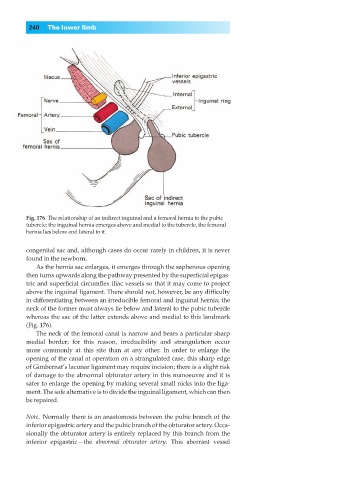
                Fig. 176◊The relationship of an indirect inguinal and a femoral hernia to the pubic
                tubercle; the inguinal hernia emerges above and medial to the tubercle, the femoral
                hernia lies below and lateral to it.

                congenital sac and, although cases do occur rarely in children, it is never
                found in the newborn.
                   As the hernia sac enlarges, it emerges through the saphenous opening
                then turns upwards along the pathway presented by the superficial epigas-
                tric and superficial circumflex iliac vessels so that it may come to project
                above the inguinal ligament. There should not, however, be any difficulty
                in differentiating between an irreducible femoral and inguinal hernia; the
                neck of the former must always lie below and lateral to the pubic tubercle
                whereas the sac of the latter extends above and medial to this landmark
                (Fig. 176).
                   The neck of the femoral canal is narrow and bears a particular sharp
                medial border; for this reason, irreducibility and strangulation occur
                more commonly at this site than at any other. In order to enlarge the
                opening of the canal at operation on a strangulated case, this sharp edge
                of Gimbernat’s lacunar ligament may require incision; there is a slight risk
                of damage to the abnormal obturator artery in this manoeuvre and it is
                safer to enlarge the opening by making several small nicks into the liga-
                ment. The safe alternative is to divide the inguinal ligament, which can then
                be repaired.

                Note.◊Normally there is an anastomosis between the pubic branch of the
                inferior epigastric artery and the pubic branch of the obturator artery. Occa-
                sionally the obturator artery is entirely replaced by this branch from the
                inferior epigastric —the  abnormal obturator artery. This aberrant vessel

