


Page 294 - Clinical Anatomy
P. 294
ECA5  7/18/06  6:50 PM  Page 279


                                                                                The pharynx    279


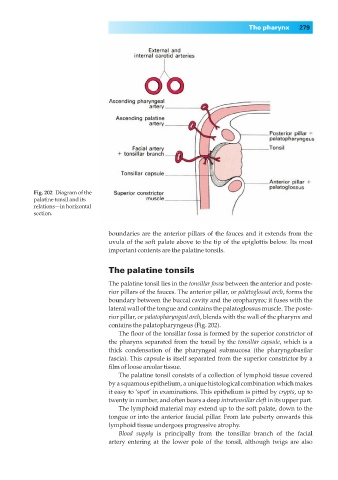
                  Fig. 202◊Diagram of the
                  palatine tonsil and its
                  relations—in horizontal
                  section.


                                       boundaries are the anterior pillars of the fauces and it extends from the
                                       uvula of the soft palate above to the tip of the epiglottis below. Its most
                                       important contents are the palatine tonsils.

                                       The palatine tonsils

                                       The palatine tonsil lies in the tonsillar fossa between the anterior and poste-
                                       rior pillars of the fauces. The anterior pillar, or palatoglossal arch, forms the
                                       boundary between the buccal cavity and the oropharynx; it fuses with the
                                       lateral wall of the tongue and contains the palatoglossus muscle. The poste-
                                       rior pillar, or palatopharyngeal arch, blends with the wall of the pharynx and
                                       contains the palatopharyngeus (Fig. 202).
                                          The floor of the tonsillar fossa is formed by the superior constrictor of
                                       the pharynx separated from the tonsil by the tonsillar capsule, which is a
                                       thick condensation of the pharyngeal submucosa (the pharyngobasilar
                                       fascia). This capsule is itself separated from the superior constrictor by a
                                       film of loose areolar tissue.
                                          The palatine tonsil consists of a collection of lymphoid tissue covered
                                       by a squamous epithelium, a unique histological combination which makes
                                       it easy to ‘spot’ in examinations. This epithelium is pitted by crypts, up to
                                       twenty in number, and often bears a deep intratonsillar cleft in its upper part.
                                          The lymphoid material may extend up to the soft palate, down to the
                                       tongue or into the anterior faucial pillar. From late puberty onwards this
                                       lymphoid tissue undergoes progressive atrophy.
                                          Blood supply is principally from the tonsillar branch of the facial
                                       artery entering at the lower pole of the tonsil, although twigs are also

