


Page 290 - Clinical Anatomy
P. 290
ECA5  7/18/06  6:50 PM  Page 275


                                                           The tongue and floor of the mouth    275


                                       Nerve supply

                                       The anterior two-thirds of the tongue receives its sensory supply from the
                                       lingual branch of V which also transmits the gustatory fibres of the chorda
                                       tympani (VII).
                                          Common sensation and taste to the posterior one-third, including the
                                       vallate papillae, are derived from IX. A few fibres of the superior laryngeal
                                       nerve (X) carry sensory fibres from the posterior part of the tongue.
                                          All the muscles of the tongue except palatoglossus are supplied by XII;
                                       palatoglossus, a muscle of the soft palate, is innervated by the pharyngeal
                                       branch of X.

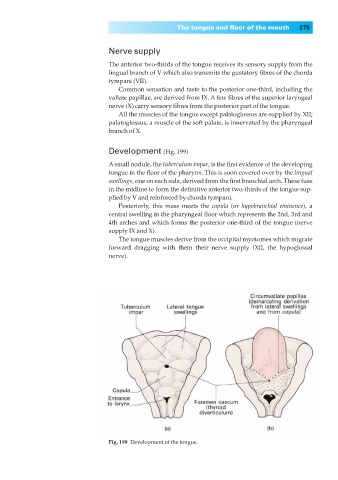
                                       Development (Fig. 199)

                                        Asmall nodule, the tuberculum impar, is the first evidence of the developing
                                        tongue in the floor of the pharynx. This is soon covered over by the lingual
                                        swellings, one on each side, derived from the first branchial arch. These fuse
                                        in the midline to form the definitive anterior two-thirds of the tongue sup-
                                        plied by V and reinforced by chorda tympani.
                                          Posteriorly, this mass meets the  copula (or  hypobranchial eminence), a
                                       central swelling in the pharyngeal floor which represents the 2nd, 3rd and
                                       4th arches and which forms the posterior one-third of the tongue (nerve
                                       supply IX and X).
                                          The tongue muscles derive from the occipital myotomes which migrate
                                       forward dragging with them their nerve supply (XII, the hypoglossal
                                       nerve).


                                        Fig. 199◊Development of the tongue.

