


Page 289 - Clinical Anatomy
P. 289
ECA5  7/18/06  6:50 PM  Page 274


                 274  The head and neck


                palatoglossus. The functions of the individual extrinsic muscles can be
                deduced from their relative positions (Fig. 197). Genioglossus protrudes
                the tongue, styloglossus retracts it and hyoglossus depresses it. Palatoglos-
                sus is, in fact, a palatal muscle and helps to narrow the oropharynx in
                swallowing.

                Blood supply

                Blood is supplied from the lingual branch of the external carotid artery.
                There is little cross-circulation across the median raphe, which is therefore a
                relatively avascular plane.


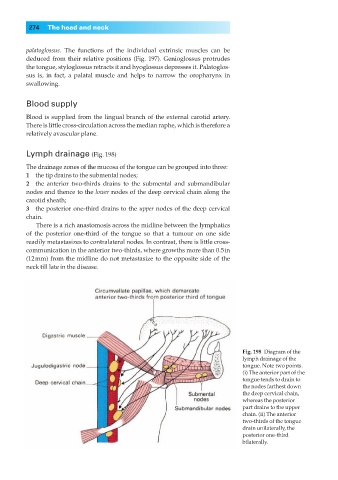
                Lymph drainage (Fig. 198)
                The drainage zones of the mucosa of the tongue can be grouped into three:
                1◊◊the tip drains to the submental nodes;
                2◊◊the anterior two-thirds drains to the submental and submandibular
                nodes and thence to the lower nodes of the deep cervical chain along the
                carotid sheath;
                3◊◊the posterior one-third drains to the upper nodes of the deep cervical
                chain.
                   There is a rich anastomosis across the midline between the lymphatics
                of the posterior one-third of the tongue so that a tumour on one side
                readily metastasizes to contralateral nodes. In contrast, there is little cross-
                communication in the anterior two-thirds, where growths more than 0.5in
                (12mm) from the midline do not metastasize to the opposite side of the
                neck till late in the disease.


                                                                              Fig. 198◊Diagram of the
                                                                              lymph drainage of the
                                                                              tongue. Note two points.
                                                                              (i) The anterior part of the
                                                                              tongue tends to drain to
                                                                              the nodes farthest down
                                                                              the deep cervical chain,
                                                                              whereas the posterior
                                                                              part drains to the upper
                                                                              chain. (ii) The anterior
                                                                              two-thirds of the tongue
                                                                              drain unilaterally, the
                                                                              posterior one-third
                                                                              bilaterally.

