


Page 358 - Clinical Anatomy
P. 358
ECA6  7/18/06  6:54 PM  Page 343


                                                                                   The brain   343


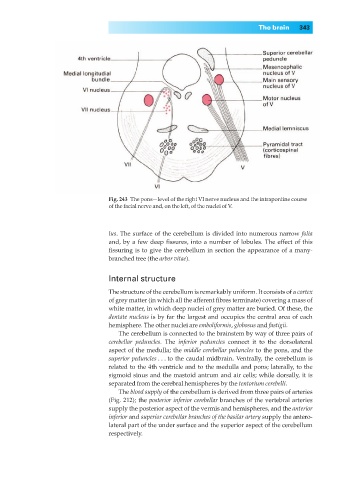
                                        Fig. 243◊The pons—level of the right VI nerve nucleus and the intrapontine course
                                        of the facial nerve and, on the left, of the nuclei of V.


                                        lus. The surface of the cerebellum is divided into numerous narrow folia
                                        and, by a few deep fissures, into a number of lobules. The effect of this
                                        fissuring is to give the cerebellum in section the appearance of a many-
                                        branched tree (the arbor vitae).


                                        Internal structure
                                        The structure of the cerebellum is remarkably uniform. It consists of a cortex
                                        of grey matter (in which all the afferent fibres terminate) covering a mass of
                                        white matter, in which deep nuclei of grey matter are buried. Of these, the
                                        dentate nucleus is by far the largest and occupies the central area of each
                                        hemisphere. The other nuclei are emboliformis, globosus and fastigii.
                                          The cerebellum is connected to the brainstem by way of three pairs of
                                        cerebellar peduncles. The  inferior peduncles connect it to the dorsolateral
                                        aspect of the medulla; the middle cerebellar peduncles to the pons, and the
                                        superior peduncles ... to the caudal midbrain. Ventrally, the cerebellum is
                                        related to the 4th ventricle and to the medulla and pons; laterally, to the
                                        sigmoid sinus and the mastoid antrum and air cells; while dorsally, it is
                                        separated from the cerebral hemispheres by the tentorium cerebelli.
                                          The blood supply of the cerebellum is derived from three pairs of arteries
                                        (Fig. 212); the posterior inferior cerebellar branches of the vertebral arteries
                                        supply the posterior aspect of the vermis and hemispheres, and the anterior
                                        inferior and superior cerebellar branches of the basilar artery supply the antero-
                                        lateral part of the under surface and the superior aspect of the cerebellum
                                        respectively.

