


Page 359 - Clinical Anatomy
P. 359
ECA6  7/18/06  6:54 PM  Page 344


                 344  The central nervous system


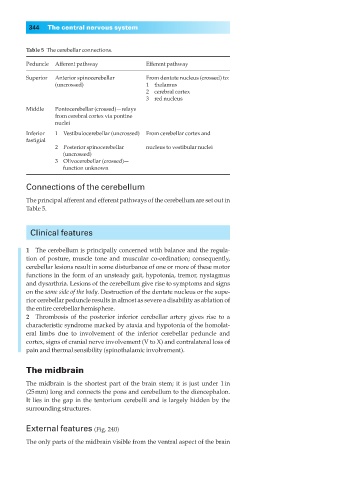
                Table 5◊The cerebellar connections.

                Peduncle  Afferent pathway        Efferent pathway
                Superior  Anterior spinocerebellar   From dentate nucleus (crossed) to:
                        (uncrossed)               1◊◊thalamus
                                                  2◊◊cerebral cortex
                                                  3◊◊red nucleus
                Middle  Pontocerebellar (crossed)—relays
                        from cerebral cortex via pontine
                        nuclei
                Inferior  1◊◊Vestibulocerebellar (uncrossed)  From cerebellar cortex and
                fastigial
                        2◊◊Posterior spinocerebellar  nucleus to vestibular nuclei
                        ◊◊1(uncrossed)
                        3◊◊Olivocerebellar (crossed)—
                        ◊◊1function unknown


                Connections of the cerebellum
                The principal afferent and efferent pathways of the cerebellum are set out in
                Table 5.


                 Clinical features

                1◊◊The cerebellum is principally concerned with balance and the regula-
                tion of posture, muscle tone and muscular co-ordination; consequently,
                cerebellar lesions result in some disturbance of one or more of these motor
                functions in the form of an unsteady gait, hypotonia, tremor, nystagmus
                and dysarthria. Lesions of the cerebellum give rise to symptoms and signs
                on the same side of the body. Destruction of the dentate nucleus or the supe-
                rior cerebellar peduncle results in almost as severe a disability as ablation of
                the entire cerebellar hemisphere.
                2◊◊Thrombosis of the posterior inferior cerebellar artery gives rise to a
                characteristic syndrome marked by ataxia and hypotonia of the homolat-
                eral limbs due to involvement of the inferior cerebellar peduncle and
                cortex, signs of cranial nerve involvement (V to X) and contralateral loss of
                pain and thermal sensibility (spinothalamic involvement).

                The midbrain

                The midbrain is the shortest part of the brain stem; it is just under 1in
                (25mm) long and connects the pons and cerebellum to the diencephalon.
                It lies in the gap in the tentorium cerebelli and is largely hidden by the
                surrounding structures.

                External features (Fig. 240)

                The only parts of the midbrain visible from the ventral aspect of the brain

