


Page 405 - Clinical Anatomy
P. 405
ECA6  7/18/06  6:54 PM  Page 390


                 390  The central nervous system


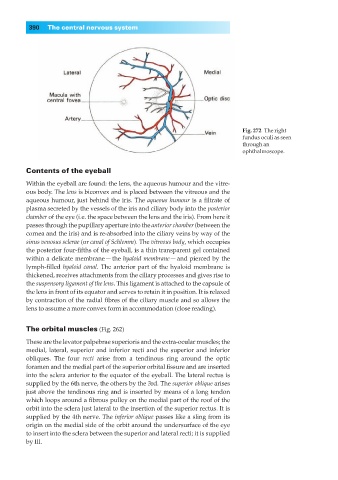
                                                                              Fig. 272◊The right
                                                                              fundus oculi as seen
                                                                              through an
                                                                              ophthalmoscope.


                Contents of the eyeball
                Within the eyeball are found: the lens, the aqueous humour and the vitre-
                ous body. The lens is biconvex and is placed between the vitreous and the
                aqueous humour, just behind the iris. The aqueous humour is a filtrate of
                plasma secreted by the vessels of the iris and ciliary body into the posterior
                chamber of the eye (i.e. the space between the lens and the iris). From here it
                passes through the pupillary aperture into the anterior chamber (between the
                cornea and the iris) and is re-absorbed into the ciliary veins by way of the
                sinus venosus sclerae (or canal of Schlemm). The vitreous body, which occupies
                the posterior four-fifths of the eyeball, is a thin transparent gel contained
                within a delicate membrane — the hyaloid membrane — and pierced by the
                lymph-filled hyaloid canal. The anterior part of the hyaloid membrane is
                thickened, receives attachments from the ciliary processes and gives rise to
                the suspensory ligament of the lens. This ligament is attached to the capsule of
                the lens in front of its equator and serves to retain it in position. It is relaxed
                by contraction of the radial fibres of the ciliary muscle and so allows the
                lens to assume a more convex form in accommodation (close reading).

                The orbital muscles (Fig. 262)

                These are the levator palpebrae superioris and the extra-ocular muscles; the
                medial, lateral, superior and inferior recti and the superior and inferior
                obliques. The four  recti arise from a tendinous ring around the optic
                foramen and the medial part of the superior orbital fissure and are inserted
                into the sclera anterior to the equator of the eyeball. The lateral rectus is
                supplied by the 6th nerve, the others by the 3rd. The superior oblique arises
                just above the tendinous ring and is inserted by means of a long tendon
                which loops around a fibrous pulley on the medial part of the roof of the
                orbit into the sclera just lateral to the insertion of the superior rectus. It is
                supplied by the 4th nerve. The inferior oblique passes like a sling from its
                origin on the medial side of the orbit around the undersurface of the eye
                to insert into the sclera between the superior and lateral recti; it is supplied
                by III.

