


Page 407 - Clinical Anatomy
P. 407
ECA6  7/18/06  6:54 PM  Page 392


                 392  The central nervous system


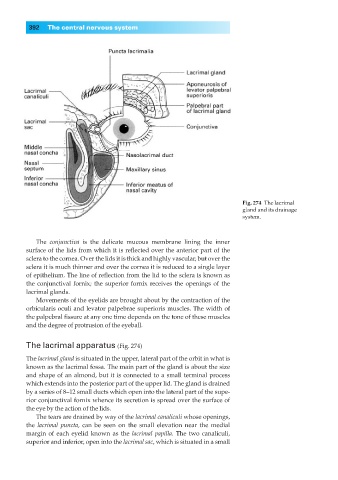
                                                                              Fig. 274◊The lacrimal
                                                                              gland and its drainage
                                                                              system.


                   The  conjunctiva is the delicate mucous membrane lining the inner
                surface of the lids from which it is reflected over the anterior part of the
                sclera to the cornea. Over the lids it is thick and highly vascular, but over the
                sclera it is much thinner and over the cornea it is reduced to a single layer
                of epithelium. The line of reflection from the lid to the sclera is known as
                the conjunctival fornix; the superior fornix receives the openings of the
                lacrimal glands.
                   Movements of the eyelids are brought about by the contraction of the
                orbicularis oculi and levator palpebrae superioris muscles. The width of
                the palpebral fissure at any one time depends on the tone of these muscles
                and the degree of protrusion of the eyeball.


                The lacrimal apparatus (Fig. 274)
                The lacrimal gland is situated in the upper, lateral part of the orbit in what is
                known as the lacrimal fossa. The main part of the gland is about the size
                and shape of an almond, but it is connected to a small terminal process
                which extends into the posterior part of the upper lid. The gland is drained
                by a series of 8–12 small ducts which open into the lateral part of the supe-
                rior conjunctival fornix whence its secretion is spread over the surface of
                the eye by the action of the lids.
                   The tears are drained by way of the lacrimal canaliculi whose openings,
                the  lacrimal puncta, can be seen on the small elevation near the medial
                margin of each eyelid known as the lacrimal papilla. The two canaliculi,
                superior and inferior, open into the lacrimal sac, which is situated in a small

