


Page 79 - Clinical Anatomy
P. 79
ECA2  7/18/06  6:42 PM  Page 64


                 64  The abdomen and pelvis


                Relations
                •◊◊Anteriorly — the skin, superficial fascia and the external oblique
                aponeurosis cover the full length of the canal; the internal oblique covers its
                lateral one-third.
                •◊◊Posteriorly — the conjoint tendon forms the posterior wall of the canal
                medially, the transversalis fascia laterally. (The conjoint tendon represents
                the fused common insertion of the internal oblique and transversus into the
                pubic crest and pectineal line.)
                •◊◊Above — arch the lowest fibres of the internal oblique and transversus
                abdominis.
                •◊◊Below—lies the inguinal ligament.
                   The internal (or deep) ring represents the point at which the spermatic
                cord pushes through the transversalis fascia, dragging from it a covering
                which forms the internal spermatic fascia. This ring is demarcated medially
                by the inferior epigastric vessels passing upwards from the external iliac
                artery and vein.
                   The  external (or superficial)  ring is a V-shaped defect in the external
                oblique aponeurosis and lies immediately above and medial to the pubic
                tubercle. As the cord traverses this opening, it carries the external spermatic
                fascia from the ring’s margins.
                   The inguinal canal transmits the spermatic cord and the ilio-inguinal
                nerve in the male and the round ligament and ilio-inguinal nerve in the
                female.
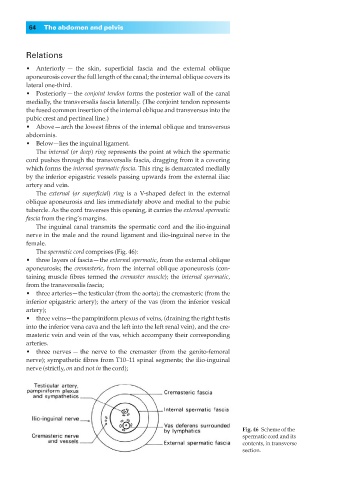
                   The spermatic cord comprises (Fig. 46):
                •◊◊three layers of fascia— the external spermatic, from the external oblique
                aponeurosis; the cremasteric, from the internal oblique aponeurosis (con-
                taining muscle fibres termed the cremaster muscle); the internal spermatic,
                from the transversalis fascia;
                •◊◊three arteries—the testicular (from the aorta); the cremasteric (from the
                inferior epigastric artery); the artery of the vas (from the inferior vesical
                artery);
                •◊◊three veins—the pampiniform plexus of veins, (draining the right testis
                into the inferior vena cava and the left into the left renal vein), and the cre-
                masteric vein and vein of the vas, which accompany their corresponding
                arteries.
                •◊◊three nerves — the nerve to the cremaster (from the genito-femoral
                nerve); sympathetic fibres from T10–11 spinal segments; the ilio-inguinal
                nerve (strictly, on and not in the cord);


                                                                              Fig. 46◊Scheme of the
                                                                              spermatic cord and its
                                                                              contents, in transverse
                                                                              section.

