


Page 81 - Clinical Anatomy
P. 81
ECA2  7/18/06  6:42 PM  Page 66


                 66  The abdomen and pelvis


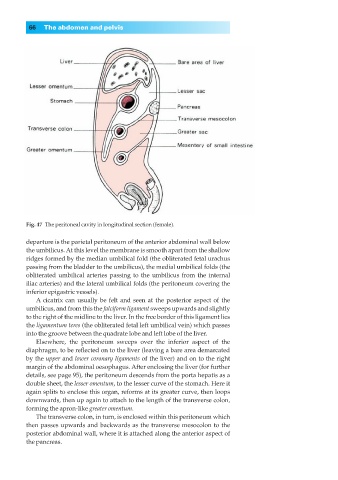
                Fig. 47◊The peritoneal cavity in longitudinal section (female).


                departure is the parietal peritoneum of the anterior abdominal wall below
                the umbilicus. At this level the membrane is smooth apart from the shallow
                ridges formed by the median umbilical fold (the obliterated fetal urachus
                passing from the bladder to the umbilicus), the medial umbilical folds (the
                obliterated umbilical arteries passing to the umbilicus from the internal
                iliac arteries) and the lateral umbilical folds (the peritoneum covering the
                inferior epigastric vessels).
                   A cicatrix can usually be felt and seen at the posterior aspect of the
                umbilicus, and from this the falciform ligament sweeps upwards and slightly
                to the right of the midline to the liver. In the free border of this ligament lies
                the ligamentum teres (the obliterated fetal left umbilical vein) which passes
                into the groove between the quadrate lobe and left lobe of the liver.
                   Elsewhere, the peritoneum sweeps over the inferior aspect of the
                diaphragm, to be reflected on to the liver (leaving a bare area demarcated
                by the upper and lower coronary ligaments of the liver) and on to the right
                margin of the abdominal oesophagus. After enclosing the liver (for further
                details, see page 95), the peritoneum descends from the porta hepatis as a
                double sheet, the lesser omentum, to the lesser curve of the stomach. Here it
                again splits to enclose this organ, reforms at its greater curve, then loops
                downwards, then up again to attach to the length of the transverse colon,
                forming the apron-like greater omentum.
                   The transverse colon, in turn, is enclosed within this peritoneum which
                then passes upwards and backwards as the transverse mesocolon to the
                posterior abdominal wall, where it is attached along the anterior aspect of
                the pancreas.

