


Page 83 - Clinical Anatomy
P. 83
ECA2  7/18/06  6:42 PM  Page 68


                 68  The abdomen and pelvis


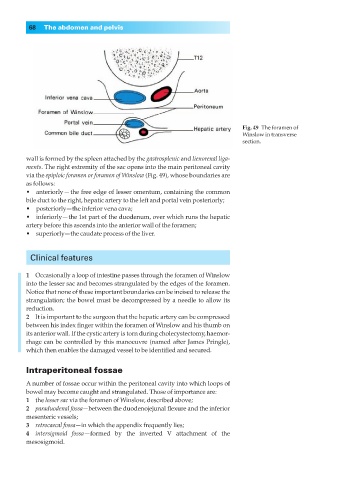
                                                                              Fig. 49◊The foramen of
                                                                              Winslow in transverse
                                                                              section.
                wall is formed by the spleen attached by the gastrosplenic and lienorenal liga-
                ments. The right extremity of the sac opens into the main peritoneal cavity
                via the epiploic foramen or foramen of Winslow (Fig. 49), whose boundaries are
                as follows:
                •◊◊anteriorly — the free edge of lesser omentum, containing the common
                bile duct to the right, hepatic artery to the left and portal vein posteriorly;
                •◊◊posteriorly—the inferior vena cava;
                •◊◊inferiorly— the 1st part of the duodenum, over which runs the hepatic
                artery before this ascends into the anterior wall of the foramen;
                •◊◊superiorly—the caudate process of the liver.


                 Clinical features


                1◊◊Occasionally a loop of intestine passes through the foramen of Winslow
                into the lesser sac and becomes strangulated by the edges of the foramen.
                Notice that none of these important boundaries can be incised to release the
                strangulation; the bowel must be decompressed by a needle to allow its
                reduction.
                2◊◊It is important to the surgeon that the hepatic artery can be compressed
                between his index finger within the foramen of Winslow and his thumb on
                its anterior wall. If the cystic artery is torn during cholecystectomy, haemor-
                rhage can be controlled by this manoeuvre (named after James Pringle),
                which then enables the damaged vessel to be identified and secured.

                Intraperitoneal fossae

                A number of fossae occur within the peritoneal cavity into which loops of
                bowel may become caught and strangulated. Those of importance are:
                1◊◊the lesser sac via the foramen of Winslow, described above;
                2◊◊paraduodenal fossa—between the duodenojejunal flexure and the inferior
                mesenteric vessels;
                3◊◊retrocaecal fossa—in which the appendix frequently lies;
                4◊◊intersigmoid fossa—formed by the inverted V attachment of the
                mesosigmoid.

