


Page 84 - Clinical Anatomy
P. 84
ECA2  7/18/06  6:42 PM  Page 69


                                                                             Peritoneal cavity  69


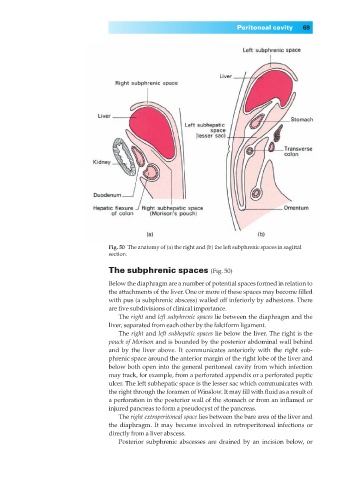
                                        Fig. 50◊The anatomy of (a) the right and (b) the left subphrenic spaces in sagittal
                                        section.

                                        The subphrenic spaces (Fig. 50)
                                        Below the diaphragm are a number of potential spaces formed in relation to
                                        the attachments of the liver. One or more of these spaces may become filled
                                        with pus (a subphrenic abscess) walled off inferiorly by adhesions. There
                                        are five subdivisions of clinical importance.
                                          The right and left subphrenic spaces lie between the diaphragm and the
                                        liver, separated from each other by the falciform ligament.
                                          The right and left subhepatic spaces lie below the liver. The right is the
                                        pouch of Morison and is bounded by the posterior abdominal wall behind
                                        and by the liver above. It communicates anteriorly with the right sub-
                                        phrenic space around the anterior margin of the right lobe of the liver and
                                        below both open into the general peritoneal cavity from which infection
                                        may track, for example, from a perforated appendix or a perforated peptic
                                        ulcer. The left subhepatic space is the lesser sac which communicates with
                                        the right through the foramen of Winslow. It may fill with fluid as a result of
                                        a perforation in the posterior wall of the stomach or from an inflamed or
                                        injured pancreas to form a pseudocyst of the pancreas.
                                          The right extraperitoneal space lies between the bare area of the liver and
                                        the diaphragm. It may become involved in retroperitoneal infections or
                                        directly from a liver abscess.
                                          Posterior subphrenic abscesses are drained by an incision below, or

