


Page 127 - Clinical Application of Mechanical Ventilation
P. 127
Operating Modes of Mechanical Ventilation  93


                                                      60
                                                      50
                                                    Airway Pressure (cm H 2 O)  40


                                                      30
                                                      20
                                                      10
                                                                                                              © Cengage Learning 2014
                                                       0

                                                     –10

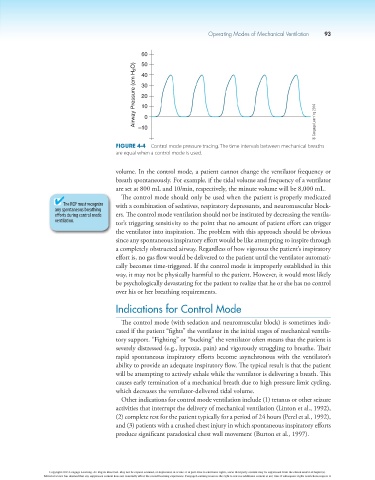
                                             Figure 4-4  Control mode pressure tracing. The time intervals between mechanical breaths
                                             are equal when a control mode is used.

                                             volume. In the control mode, a patient cannot change the ventilator frequency or
                                             breath spontaneously. For example, if the tidal volume and frequency of a ventilator
                                             are set at 800 mL and 10/min, respectively, the minute volume will be 8,000 mL.
                                               The control mode should only be used when the patient is properly medicated
                            The RCP must recognize   with a combination of sedatives, respiratory depressants, and neuromuscular block-
                          any spontaneous breathing
                          efforts during control mode   ers. The control mode ventilation should not be instituted by decreasing the ventila-
                          ventilation.       tor’s triggering sensitivity to the point that no amount of patient effort can trigger
                                             the ventilator into inspiration. The problem with this approach should be obvious
                                             since any spontaneous inspiratory effort would be like attempting to inspire through
                                             a completely obstructed airway. Regardless of how vigorous the patient’s inspiratory
                                             effort is, no gas flow would be delivered to the patient until the ventilator automati-
                                             cally becomes time-triggered. If the control mode is improperly established in this
                                             way, it may not be physically harmful to the patient. However, it would most likely
                                             be psychologically devastating for the patient to realize that he or she has no control
                                             over his or her breathing requirements.

                                             Indications for Control Mode

                                               The control mode (with sedation and neuromuscular block) is sometimes indi-
                                             cated if the patient “fights” the ventilator in the initial stages of mechanical ventila-
                                             tory support. “Fighting” or “bucking” the ventilator often means that the patient is
                                             severely distressed (e.g., hypoxia, pain) and vigorously struggling to breathe. Their
                                             rapid spontaneous inspiratory efforts become asynchronous with the ventilator’s
                                             ability to provide an adequate inspiratory flow. The typical result is that the patient
                                             will be attempting to actively exhale while the ventilator is delivering a breath. This
                                             causes early termination of a mechanical breath due to high pressure limit cycling,
                                             which decreases the ventilator-delivered tidal volume.
                                               Other indications for control mode ventilation include (1) tetanus or other seizure
                                             activities that interrupt the delivery of mechanical ventilation (Linton et al., 1992),
                                             (2) complete rest for the patient typically for a period of 24 hours (Perel et al., 1992),
                                             and (3) patients with a crushed chest injury in which spontaneous inspiratory efforts
                                             produce significant paradoxical chest wall movement (Burton et al., 1997).


                        Copyright 2013 Cengage Learning. All Rights Reserved. May not be copied, scanned, or duplicated, in whole or in part. Due to electronic rights, some third party content may be suppressed from the eBook and/or eChapter(s).
                      Editorial review has deemed that any suppressed content does not materially affect the overall learning experience. Cengage Learning reserves the right to remove additional content at any time if subsequent rights restrictions require it.

