


Page 161 - Clinical Application of Mechanical Ventilation
P. 161
Special Airways for Ventilation  127


                                                                                                               © Cengage Learning 2014


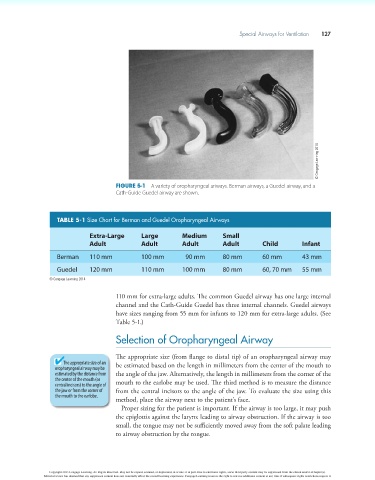
                                             Figure 5-1  A variety of oropharyngeal ariways. Berman airways, a Guedel airway, and a
                                             Cath-Guide Guedel airway are shown.


                          TABLE 5-1 Size Chart for Berman and Guedel Oropharyngeal Airways

                                     Extra-Large      Large        Medium       Small
                                     Adult            Adult        Adult        Adult        Child        Infant

                          Berman     110 mm           100 mm        90 mm       80 mm        60 mm        43 mm
                          Guedel     120 mm           110 mm       100 mm       80 mm        60, 70 mm    55 mm
                        © Cengage Learning 2014


                                             110 mm for extra-large adults. The common Guedel airway has one large internal
                                             channel and the Cath-Guide Guedel has three internal channels. Guedel airways
                                             have sizes ranging from 55 mm for infants to 120 mm for extra-large adults. (See
                                             Table 5-1.)

                                             Selection of Oropharyngeal Airway


                                             The appropriate size (from flange to distal tip) of an oropharyngeal airway may
                            The appropriate size of an   be estimated based on the length in millimeters from the center of the mouth to
                          oropharyngeal airway may be
                          estimated by the distance from   the angle of the jaw. Alternatively, the length in millimeters from the corner of the
                          the center of the mouth (or   mouth to the earlobe may be used. The third method is to measure the distance
                          central incisors) to the angle of
                          the jaw or from the corner of   from the central incisors to the angle of the jaw. To evaluate the size using this
                          the mouth to the earlobe.
                                             method, place the airway next to the patient’s face.
                                               Proper sizing for the patient is important. If the airway is too large, it may push
                                             the epiglottis against the larynx leading to airway obstruction. If the airway is too
                                             small, the tongue may not be sufficiently moved away from the soft palate leading
                                             to airway obstruction by the tongue.


                        Copyright 2013 Cengage Learning. All Rights Reserved. May not be copied, scanned, or duplicated, in whole or in part. Due to electronic rights, some third party content may be suppressed from the eBook and/or eChapter(s).
                      Editorial review has deemed that any suppressed content does not materially affect the overall learning experience. Cengage Learning reserves the right to remove additional content at any time if subsequent rights restrictions require it.

