


Page 163 - Clinical Application of Mechanical Ventilation
P. 163
Special Airways for Ventilation  129


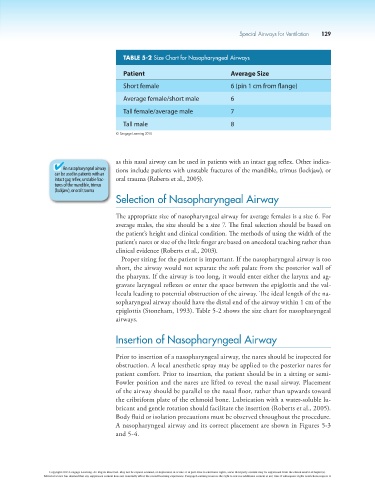
                                                TABLE 5-2 Size Chart for Nasopharyngeal Airways

                                                Patient                            Average Size

                                                Short female                       6 (pin 1 cm from flange)

                                                Average female/short male          6
                                                Tall female/average male           7

                                                Tall male                          8
                                             © Cengage Learning 2014


                                             as this nasal airway can be used in patients with an intact gag reflex. Other indica-
                            An nasopharyngeal airway   tions include patients with unstable fractures of the mandible, trimus (lockjaw), or
                         can be used in patients with an
                         intact gag reflex, unstable frac-  oral trauma (Roberts et al., 2005).
                         tures of the mandible, trimus
                         (lockjaw), or oral trauma
                                             Selection of Nasopharyngeal Airway


                                             The appropriate size of nasopharyngeal airway for average females is a size 6. For
                                             average males, the size should be a size 7. The final selection should be based on
                                             the patient’s height and clinical condition. The methods of using the width of the
                                             patient’s nares or size of the little finger are based on anecdotal teaching rather than
                                             clinical evidence (Roberts et al., 2003).
                                               Proper sizing for the patient is important. If the nasopharyngeal airway is too
                                             short, the airway would not separate the soft palate from the posterior wall of
                                             the pharynx. If the airway is too long, it would enter either the larynx and ag-
                                             gravate laryngeal reflexes or enter the space between the epiglottis and the val-
                                             lecula leading to potential obstruction of the airway. The ideal length of the na-
                                             sopharyngeal airway should have the distal end of the airway within 1 cm of the
                                             epiglottis (Stoneham, 1993). Table 5-2 shows the size chart for nasopharyngeal
                                             airways.


                                             Insertion of Nasopharyngeal Airway


                                             Prior to insertion of a nasopharyngeal airway, the nares should be inspected for
                                             obstruction. A local anesthetic spray may be applied to the posterior nares for
                                             patient comfort. Prior to insertion, the patient should be in a sitting or semi-
                                             Fowler position and the nares are lifted to reveal the nasal airway. Placement
                                             of the airway should be parallel to the nasal floor, rather than upwards toward
                                             the cribriform plate of the ethmoid bone. Lubrication with a water-soluble lu-
                                             bricant and gentle rotation should facilitate the insertion (Roberts et al., 2005).
                                             Body fluid or isolation precautions must be observed throughout the procedure.
                                             A nasopharyngeal airway and its correct placement are shown in Figures 5-3
                                             and 5-4.


                        Copyright 2013 Cengage Learning. All Rights Reserved. May not be copied, scanned, or duplicated, in whole or in part. Due to electronic rights, some third party content may be suppressed from the eBook and/or eChapter(s).
                      Editorial review has deemed that any suppressed content does not materially affect the overall learning experience. Cengage Learning reserves the right to remove additional content at any time if subsequent rights restrictions require it.

