


Page 164 - Clinical Application of Mechanical Ventilation
P. 164
130    Chapter 5


                                                                                                        © Cengage Learning 2014


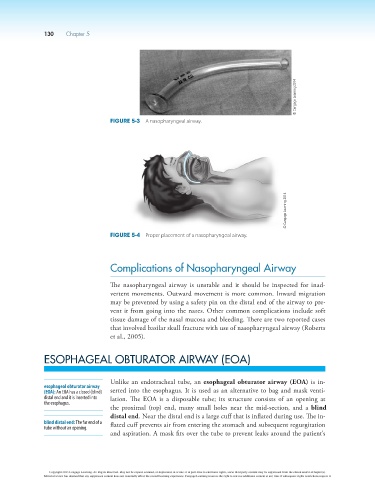
                                            Figure 5-3  A nasopharyngeal airway.


                                                                                                     © Cengage Learning 2014


                                            Figure 5-4  Proper placement of a nasopharyngeal airway.


                                            Complications of Nasopharyngeal Airway


                                            The  nasopharyngeal  airway  is  unstable  and  it  should  be  inspected  for  inad-
                                            vertent movements. Outward movement is more common. Inward migration
                                            may be prevented by using a safety pin on the distal end of the airway to pre-
                                            vent it from going into the nares. Other common complications include soft
                                            tissue damage of the nasal mucosa and bleeding. There are two reported cases
                                            that involved basilar skull fracture with use of nasopharyngeal airway (Roberts
                                            et al., 2005).


                      ESOphAGEAL OBTuRATOR AIRwAy (EOA)


                                            Unlike an endotracheal tube, an esophageal obturator airway (EOA) is in-
                      esophageal obturator airway
                      (EOA): An EOA has a closed (blind)   serted into the esophagus. It is used as an alternative to bag and mask venti-
                      distal end and it is inserted into   lation.  The  EOA  is  a  disposable  tube;  its  structure  consists  of  an  opening  at
                      the esophagus.
                                            the  proximal  (top)  end,  many  small  holes  near  the  mid-section,  and  a  blind
                                            distal end. Near the distal end is a large cuff that is inflated during use. The in-
                      blind distal end: The far end of a   flated cuff prevents air from entering the stomach and subsequent regurgitation
                      tube without an opening.
                                            and aspiration. A mask fits over the tube to prevent leaks around the patient’s


                        Copyright 2013 Cengage Learning. All Rights Reserved. May not be copied, scanned, or duplicated, in whole or in part. Due to electronic rights, some third party content may be suppressed from the eBook and/or eChapter(s).
                      Editorial review has deemed that any suppressed content does not materially affect the overall learning experience. Cengage Learning reserves the right to remove additional content at any time if subsequent rights restrictions require it.

