


Page 162 - Clinical Application of Mechanical Ventilation
P. 162
128    Chapter 5


                                                                                                    © Cengage Learning 2014


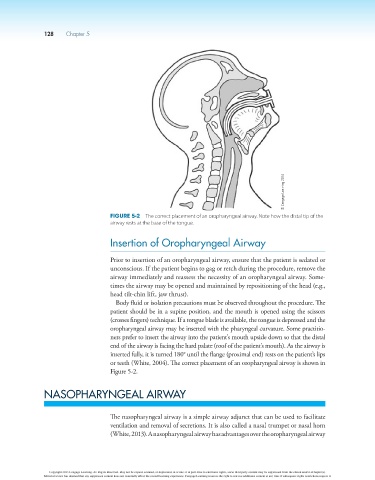
                                            Figure 5-2  The correct placement of an oropharyngeal airway. Note how the distal tip of the
                                            airway rests at the base of the tongue.

                                            Insertion of Oropharyngeal Airway


                                            Prior to insertion of an oropharyngeal airway, ensure that the patient is sedated or
                                            unconscious. If the patient begins to gag or retch during the procedure, remove the
                                            airway immediately and reassess the necessity of an oropharyngeal airway. Some-
                                            times the airway may be opened and maintained by repositioning of the head (e.g.,
                                            head tilt-chin lift, jaw thrust).
                                             Body fluid or isolation precautions must be observed throughout the procedure. The
                                            patient should be in a supine position, and the mouth is opened using the scissors
                                            (crosses fingers) technique. If a tongue blade is available, the tongue is depressed and the
                                            oropharyngeal airway may be inserted with the pharyngeal curvature. Some practitio-
                                            ners prefer to insert the airway into the patient’s mouth upside down so that the distal
                                            end of the airway is facing the hard palate (roof of the patient’s mouth). As the airway is
                                            inserted fully, it is turned 180° until the flange (proximal end) rests on the patient’s lips
                                            or teeth (White, 2004). The correct placement of an oropharyngeal airway is shown in
                                            Figure 5-2.


                      NASOphARyNGEAL AIRwAy


                                            The nasopharyngeal airway is a simple airway adjunct that can be used to facilitate
                                            ventilation and removal of secretions. It is also called a nasal trumpet or nasal horn
                                            (White, 2013). A nasopharyngeal airway has advantages over the oropharyngeal airway


                        Copyright 2013 Cengage Learning. All Rights Reserved. May not be copied, scanned, or duplicated, in whole or in part. Due to electronic rights, some third party content may be suppressed from the eBook and/or eChapter(s).
                      Editorial review has deemed that any suppressed content does not materially affect the overall learning experience. Cengage Learning reserves the right to remove additional content at any time if subsequent rights restrictions require it.

