


Page 165 - Clinical Application of Mechanical Ventilation
P. 165
Special Airways for Ventilation  131


                                                                                Openings


                                                                                                               © Cengage Learning 2014


                                                                                                    Blind
                                                                                                  Distal End

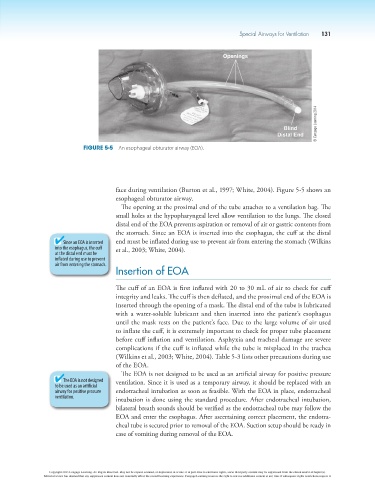
                                   Figure 5-5  An esophageal obturator airway (EOA).


                                             face during ventilation (Burton et al., 1997; White, 2004). Figure 5-5 shows an
                                             esophageal obturator airway.
                                               The opening at the proximal end of the tube attaches to a ventilation bag. The
                                             small holes at the hypopharyngeal level allow ventilation to the lungs. The closed
                                             distal end of the EOA prevents aspiration or removal of air or gastric contents from
                                             the stomach. Since an EOA is inserted into the esophagus, the cuff at the distal
                            Since an EOA is inserted   end must be inflated during use to prevent air from entering the stomach (Wilkins
                          into the esophagus, the cuff   et al., 2003; White, 2004).
                          at the distal end must be
                          inflated during use to prevent
                          air from entering the stomach.
                                             Insertion of EOA


                                             The cuff of an EOA is first inflated with 20 to 30 mL of air to check for cuff
                                             integrity and leaks. The cuff is then deflated, and the proximal end of the EOA is
                                             inserted through the opening of a mask. The distal end of the tube is lubricated
                                             with  a  water-soluble  lubricant  and  then  inserted  into  the  patient’s  esophagus
                                             until the mask rests on the patient’s face. Due to the large volume of air used
                                             to inflate the cuff, it is extremely important to check for proper tube placement
                                             before cuff inflation and ventilation. Asphyxia and tracheal damage are severe
                                             complications if the cuff is inflated while the tube is misplaced in the trachea
                                             (Wilkins et al., 2003; White, 2004). Table 5-3 lists other precautions during use
                                             of the EOA.
                                               The EOA is not designed to be used as an artificial airway for positive pressure
                            The EOA is not designed   ventilation. Since it is used as a temporary airway, it should be replaced with an
                          to be used as an artificial
                          airway for positive pressure   endotracheal intubation as soon as feasible. With the EOA in place, endotracheal
                          ventilation.       intubation is done using the standard procedure. After endotracheal intubation,
                                             bilateral breath sounds should be verified as the endotracheal tube may follow the
                                             EOA and enter the esophagus. After ascertaining correct placement, the endotra-
                                             cheal tube is secured prior to removal of the EOA. Suction setup should be ready in
                                             case of vomiting during removal of the EOA.


                        Copyright 2013 Cengage Learning. All Rights Reserved. May not be copied, scanned, or duplicated, in whole or in part. Due to electronic rights, some third party content may be suppressed from the eBook and/or eChapter(s).
                      Editorial review has deemed that any suppressed content does not materially affect the overall learning experience. Cengage Learning reserves the right to remove additional content at any time if subsequent rights restrictions require it.

