


Page 289 - Clinical Application of Mechanical Ventilation
P. 289
Monitoring in Mechanical Ventilation  255


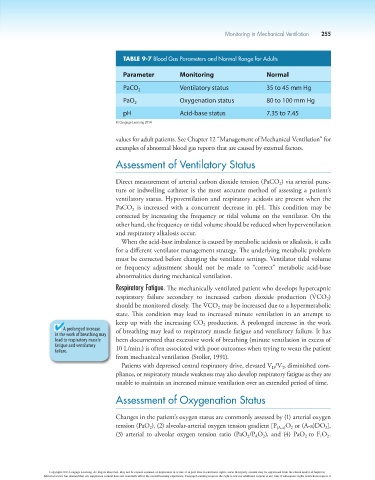
                                                TABLE 9-7 Blood Gas Parameters and Normal Range for Adults

                                                Parameter         Monitoring                   Normal

                                                PaCO 2            Ventilatory status           35 to 45 mm Hg

                                                PaO 2             Oxygenation status           80 to 100 mm Hg
                                                pH                Acid-base status             7.35 to 7.45

                                             © Cengage Learning 2014

                                             values for adult patients. See Chapter 12 “Management of Mechanical Ventilation” for
                                             examples of abnormal blood gas reports that are caused by external factors.

                                             Assessment of Ventilatory Status


                                             Direct measurement of arterial carbon dioxide tension (PaCO ) via arterial punc-
                                                                                                   2
                                             ture or indwelling catheter is the most accurate method of assessing a patient’s
                                             ventilatory status. Hypoventilation and respiratory acidosis are present when the
                                             PaCO   is  increased  with  a  concurrent  decrease  in  pH.  This  condition  may  be
                                                   2
                                             corrected by increasing the frequency or tidal volume on the ventilator. On the
                                             other hand, the frequency or tidal volume should be reduced when hyperventilation
                                             and respiratory alkalosis occur.
                                               When the acid-base imbalance is caused by metabolic acidosis or alkalosis, it calls
                                             for a different ventilator management strategy. The underlying metabolic problem
                                             must be corrected before changing the ventilator settings. Ventilator tidal volume
                                             or  frequency  adjustment  should  not  be  made  to  “correct”  metabolic  acid-base
                                             abnormalities during mechanical ventilation.
                                             Respiratory Fatigue. The mechanically ventilated patient who develops hypercapnic
                                                                                                              #
                                             respiratory  failure  secondary  to  increased  carbon  dioxide  production  (VCO )
                                                                           #
                                                                                                                  2
                                             should be monitored closely. The VCO  may be increased due to a hypermetabolic
                                                                               2
                                             state. This condition may lead to increased minute ventilation in an attempt to
                                             keep up with the increasing CO  production. A prolonged increase in the work
                                                                          2
                            A prolonged increase   of breathing may lead to respiratory muscle fatigue and ventilatory failure. It has
                          in the work of breathing may
                          lead to respiratory muscle   been documented that excessive work of breathing (minute ventilation in excess of
                          fatigue and ventilatory   10 L/min.) is often associated with poor outcomes when trying to wean the patient
                          failure.
                                             from mechanical ventilation (Stoller, 1991).
                                               Patients with depressed central respiratory drive, elevated V /V , diminished com-
                                                                                                    T
                                                                                                D
                                             pliance, or respiratory muscle weakness may also develop respiratory fatigue as they are
                                             unable to maintain an increased minute ventilation over an extended period of time.
                                             Assessment of Oxygenation Status


                                             Changes in the patient’s oxygen status are commonly assessed by (1) arterial oxygen
                                             tension (PaO ), (2) alveolar-arterial oxygen tension gradient [P (A-a) O  or (A-a)DO ],
                                                        2
                                                                                                                  2
                                                                                                      2
                                             (3)  arterial  to  alveolar  oxygen  tension  ratio  (PaO /P O ),  and  (4)  PaO to  F O .
                                                                                                                  2
                                                                                                                I
                                                                                        2
                                                                                             2
                                                                                           A
                                                                                                           2
                        Copyright 2013 Cengage Learning. All Rights Reserved. May not be copied, scanned, or duplicated, in whole or in part. Due to electronic rights, some third party content may be suppressed from the eBook and/or eChapter(s).
                      Editorial review has deemed that any suppressed content does not materially affect the overall learning experience. Cengage Learning reserves the right to remove additional content at any time if subsequent rights restrictions require it.

