


Page 288 - Clinical Application of Mechanical Ventilation
P. 288
254    Chapter 9


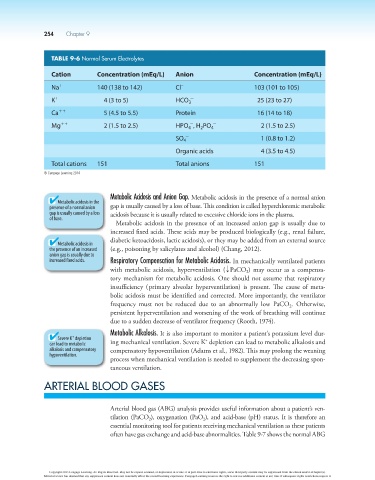
                        TABLE 9-6 Normal Serum Electrolytes

                        Cation         Concentration (mEq/L)     Anion                     Concentration (mEq/L)

                        Na 1           140 (138 to 142)          Cl –                      103 (101 to 105)

                        K 1               4 (3 to 5)             HCO 3 -                    25 (23 to 27)
                        Ca 11             5 (4.5 to 5.5)         Protein                    16 (14 to 18)

                                                                      -
                        Mg 11             2 (1.5 to 2.5)         HPO , H PO  4 -             2 (1.5 to 2.5)
                                                                         2
                                                                     4
                                                                 SO 4 -                      1 (0.8 to 1.2)
                                                                 Organic acids               4 (3.5 to 4.5)

                        Total cations  151                       Total anions              151
                      © Cengage Learning 2014


                                            Metabolic Acidosis and Anion Gap. Metabolic acidosis in the presence of a normal anion
                          Metabolic acidosis in the
                        presence of a normal anion   gap is usually caused by a loss of base. This condition is called hyperchloremic metabolic
                        gap is usually caused by a loss   acidosis because it is usually related to excessive chloride ions in the plasma.
                        of base.
                                             Metabolic acidosis in the presence of an increased anion gap is usually due to
                                            increased fixed acids. These acids may be produced biologically (e.g., renal failure,
                                            diabetic ketoacidosis, lactic acidosis), or they may be added from an external source
                          Metabolic acidosis in
                        the presence of an increased   (e.g., poisoning by salicylates and alcohol) (Chang, 2012).
                        anion gap is usually due to
                        increased fixed acids.  Respiratory Compensation for Metabolic Acidosis. In mechanically ventilated patients
                                            with  metabolic  acidosis,  hyperventilation  (TPaCO )  may  occur  as  a  compensa-
                                                                                        2
                                            tory mechanism for metabolic acidosis. One should not assume that respiratory
                                            insufficiency  ( primary  alveolar  hyperventilation)  is  present.  The  cause  of  meta-
                                            bolic acidosis must be identified and corrected. More importantly, the ventilator
                                            frequency  must  not  be  reduced  due  to  an  abnormally  low  PaCO .  Otherwise,
                                                                                                      2
                                            persistent hyperventilation and worsening of the work of breathing will continue
                                            due to a sudden decrease of ventilator frequency (Rooth, 1974).
                                            Metabolic Alkalosis. It is also important to monitor a patient’s potassium level dur-
                               +
                          Severe K  depletion                              +
                        can lead to metabolic   ing mechanical ventilation. Severe K  depletion can lead to metabolic alkalosis and
                        alkalosis and compensatory   compensatory hypoventilation (Adams et al., 1982). This may prolong the weaning
                        hypoventilation.
                                            process when mechanical ventilation is needed to supplement the decreasing spon-
                                            taneous ventilation.

                      ARTERIAL BLOOD GASES


                                            Arterial blood gas (ABG) analysis provides useful information about a patient’s ven-
                                            tilation (PaCO ), oxygenation (PaO ), and acid-base (pH) status. It is therefore an
                                                                          2
                                                        2
                                            essential monitoring tool for patients receiving mechanical ventilation as these patients
                                            often have gas exchange and acid-base abnormalities. Table 9-7 shows the normal ABG


                        Copyright 2013 Cengage Learning. All Rights Reserved. May not be copied, scanned, or duplicated, in whole or in part. Due to electronic rights, some third party content may be suppressed from the eBook and/or eChapter(s).
                      Editorial review has deemed that any suppressed content does not materially affect the overall learning experience. Cengage Learning reserves the right to remove additional content at any time if subsequent rights restrictions require it.

