


Page 299 - Clinical Application of Mechanical Ventilation
P. 299
Monitoring in Mechanical Ventilation  265


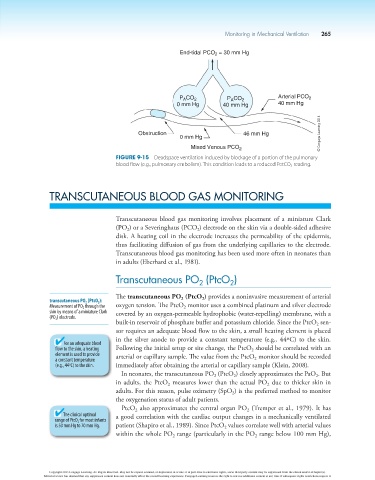
                                                                  End-tidal PCO 2  = 30 mm Hg


                                                                  P CO 2          P CO 2          Arterial PCO 2
                                                                   A
                                                                                   A
                                                                 0 mm Hg        40 mm Hg          40 mm Hg
                                                                                                                © Cengage Learning 2014

                                                     Obstruction                       46 mm Hg
                                                                  0 mm Hg
                                                                      Mixed Venous PCO 2

                                             Figure 9-15  Deadspace ventilation induced by blockage of a portion of the pulmonary
                                             blood flow (e.g., pulmonary embolism). This condition leads to a reduced PetCO 2  reading.


                        TRANSCUTANEOUS BLOOD GAS MONITORING


                                             Transcutaneous  blood  gas  monitoring  involves  placement  of  a  miniature  Clark
                                             (PO ) or a Severinghaus (PCO ) electrode on the skin via a double-sided adhesive
                                                 2
                                                                        2
                                             disk. A heating coil in the electrode increases the permeability of the epidermis,
                                             thus facilitating diffusion of gas from the underlying capillaries to the electrode.
                                             Transcutaneous blood gas monitoring has been used more often in neonates than
                                             in adults (Eberhard et al., 1981).

                                             Transcutaneous PO  (PtcO )
                                                                         2
                                                                                   2
                                             The transcutaneous PO  (PtcO ) provides a noninvasive measurement of arterial
                        transcutaneous PO 2  (PtcO 2 ):            2      2
                        Measurement of PO 2  through the   oxygen tension. The PtcO  monitor uses a combined platinum and silver electrode
                                                                    2
                        skin by means of a miniature Clark   covered by an oxygen-permeable hydrophobic (water-repelling) membrane, with a
                        (PO 2 ) electrode.
                                             built-in reservoir of phosphate buffer and potassium chloride. Since the PtcO  sen-
                                                                                                               2
                                             sor requires an adequate blood flow to the skin, a small heating element is placed
                                             in  the  silver  anode  to  provide  a  constant  temperature  (e.g.,  44ºC)  to  the  skin.
                            For an adequate blood
                          flow to the skin, a heating   Following the initial setup or site change, the PtcO  should be correlated with an
                                                                                          2
                          element is used to provide    arterial or capillary sample. The value from the PtcO  monitor should be recorded
                          a constant temperature                                           2
                          (e.g., 44ºC) to the skin.  immediately after obtaining the arterial or capillary sample (Klein, 2008).
                                               In neonates, the transcutaneous PO  (PtcO ) closely approximates the PaO . But
                                                                             2
                                                                                                               2
                                                                                    2
                                             in adults, the PtcO  measures lower than the actual PO  due to thicker skin in
                                                              2
                                                                                               2
                                             adults. For this reason, pulse oximetry (SpO ) is the preferred method to monitor
                                                                                   2
                                             the oxygenation status of adult patients.
                                               PtcO  also approximates the central organ PO  (Tremper et al., 1979). It has
                                                                                        2
                                                    2
                            The clinical optimal   a good correlation with the cardiac output changes in a mechanically ventilated
                          range of PtcO 2  for most infants
                          is 50 mm Hg to 70 mm Hg.  patient (Shapiro et al., 1989). Since PtcO  values correlate well with arterial values
                                                                                 2
                                             within the whole PO  range (particularly in the PO  range below 100 mm Hg),
                                                                2
                                                                                           2
                        Copyright 2013 Cengage Learning. All Rights Reserved. May not be copied, scanned, or duplicated, in whole or in part. Due to electronic rights, some third party content may be suppressed from the eBook and/or eChapter(s).
                      Editorial review has deemed that any suppressed content does not materially affect the overall learning experience. Cengage Learning reserves the right to remove additional content at any time if subsequent rights restrictions require it.

