


Page 298 - Clinical Application of Mechanical Ventilation
P. 298
264    Chapter 9


                                            P(a-et)CO Gradient
                                                          2

                                            The correlation between PaCO  and PetCO  is excellent and the P(a-et)CO  gra-
                                                                      2
                                                                                                             2
                                                                                  2
                          Under ideal conditions,   dient (difference) between these two measurements is about 2 mm Hg in normal
                        the PaCO 2  is about 2 mm Hg
                        higher than the PetCO 2  result-  individuals. For critical patients, a gradient of 5 mm Hg is considered acceptable
                        ing a P(a-et)CO 2  of 2 mm Hg.  (Niehoff et al., 1988).
                                             The P(a-et)CO  gradient is primarily affected by alveolar deadspace ventilation
                                                          2
                                            (Perel & Stock, 1992), old age, presence of pulmonary disease, and changes in me-
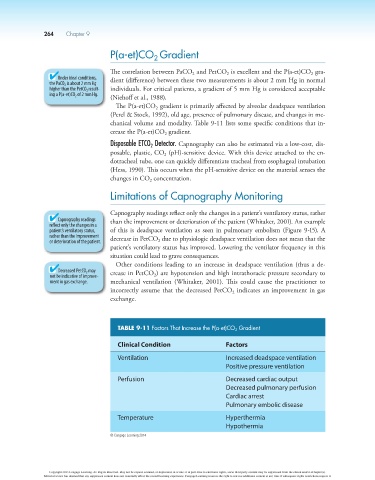
                                            chanical volume and modality. Table 9-11 lists some specific conditions that in-
                                            crease the P(a-et)CO  gradient.
                                                             2
                                            Disposable ETCO  Detector. Capnography can also be estimated via a low-cost, dis-
                                                         2
                                            posable, plastic, CO  (pH)-sensitive device. With this device attached to the en-
                                                             2
                                            dotracheal tube, one can quickly differentiate tracheal from esophageal intubation
                                            (Hess, 1990). This occurs when the pH-sensitive device on the material senses the
                                            changes in CO  concentration.
                                                        2
                                            Limitations of Capnography Monitoring


                                            Capnography readings reflect only the changes in a patient’s ventilatory status, rather
                          Capnography readings   than the improvement or deterioration of the patient (Whitaker, 2001). An example
                        reflect only the changes in a
                        patient’s ventilatory status,   of  this  is  deadspace  ventilation  as  seen  in  pulmonary  embolism  (Figure  9-15).  A
                        rather than the improvement   decrease in PetCO  due to physiologic deadspace ventilation does not mean that the
                        or deterioration of the patient.   2
                                            patient’s ventilatory status has improved. Lowering the ventilator frequency in this
                                            situation could lead to grave consequences.
                                             Other conditions leading to an increase in deadspace ventilation (thus a de-
                           Decreased PetCO 2  may   crease in PetCO ) are hypotension and high intrathoracic pressure secondary to
                        not be indicative of improve-     2
                        ment in gas exchange.  mechanical  ventilation  (Whitaker,  2001).  This  could  cause  the  practitioner  to
                                            incorrectly assume that the decreased PetCO  indicates an improvement in gas
                                                                                   2
                                            exchange.


                                              TABLE 9-11 Factors That Increase the P(a-et)CO 2  Gradient


                                              Clinical Condition                 Factors
                                              Ventilation                        Increased deadspace ventilation
                                                                                 Positive pressure ventilation

                                              Perfusion                          Decreased cardiac output
                                                                                 Decreased pulmonary perfusion
                                                                                 Cardiac arrest
                                                                                 Pulmonary embolic disease
                                              Temperature                        Hyperthermia
                                                                                 Hypothermia
                                            © Cengage Learning 2014


                        Copyright 2013 Cengage Learning. All Rights Reserved. May not be copied, scanned, or duplicated, in whole or in part. Due to electronic rights, some third party content may be suppressed from the eBook and/or eChapter(s).
                      Editorial review has deemed that any suppressed content does not materially affect the overall learning experience. Cengage Learning reserves the right to remove additional content at any time if subsequent rights restrictions require it.

