


Page 311 - Clinical Application of Mechanical Ventilation
P. 311
Hemodynamic Monitoring  277


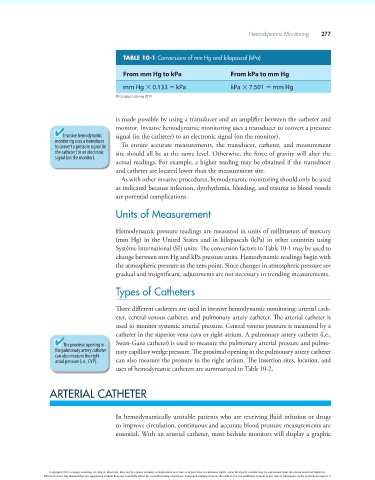
                                                TABLE 10-1 Conversions of mm Hg and kilopascal (kPa)

                                                From mm Hg to kPa                  From kPa to mm Hg

                                                mm Hg 3 0.133 5 kPa                kPa 3 7.501 5 mm Hg
                                             © Cengage Learning 2014


                                             is made possible by using a transducer and an amplifier between the catheter and
                                             monitor. Invasive hemodynamic monitoring uses a transducer to convert a pressure
                            Invasive hemodynamic   signal (in the catheter) to an electronic signal (on the monitor).
                          monitoring uses a transducer
                          to convert a pressure signal (in   To  ensure  accurate  measurements,  the  transducer,  catheter,  and  measurement
                          the catheter) to an electronic   site should all be at the same level. Otherwise, the force of gravity will alter the
                          signal (on the monitor).
                                             actual readings. For example, a higher reading may be obtained if the transducer
                                             and catheter are located lower than the measurement site.
                                               As with other invasive procedures, hemodynamic monitoring should only be used
                                             as indicated because infection, dysrhythmia, bleeding, and trauma to blood vessels
                                             are potential complications.

                                             Units of Measurement


                                             Hemodynamic pressure readings are measured in units of millimeters of mercury
                                             (mm Hg) in the United States and in kilopascals (kPa) in other countries using
                                             Système International (SI) units. The conversion factors in Table 10-1 may be used to
                                             change between mm Hg and kPa pressure units. Hemodynamic readings begin with
                                             the atmospheric pressure as the zero point. Since changes in atmospheric pressure are
                                             gradual and insignificant, adjustments are not necessary in trending measurements.

                                             Types of Catheters


                                             Three different catheters are used in invasive hemodynamic monitoring: arterial cath-
                                             eter, central venous catheter, and pulmonary artery catheter. The arterial catheter is
                                             used to monitor systemic arterial pressure. Central venous pressure is measured by a
                                             catheter in the superior vena cava or right atrium. A pulmonary artery catheter (i.e.,
                            The proximal opening in   Swan-Ganz catheter) is used to measure the pulmonary arterial pressure and pulmo-
                          the pulmonary artery catheter   nary capillary wedge pressure. The proximal opening in the pulmonary artery catheter
                          can also measure the right
                          atrial pressure (i.e., CVP).  can also measure the pressure in the right atrium. The insertion sites, location, and
                                             uses of hemodynamic catheters are summarized in Table 10-2.


                        ARTERIAL CATHETER


                                             In hemodynamically unstable patients who are receiving fluid infusion or drugs
                                             to improve circulation, continuous and accurate blood pressure measurements are
                                             essential. With an arterial catheter, most bedside monitors will display a graphic


                        Copyright 2013 Cengage Learning. All Rights Reserved. May not be copied, scanned, or duplicated, in whole or in part. Due to electronic rights, some third party content may be suppressed from the eBook and/or eChapter(s).
                      Editorial review has deemed that any suppressed content does not materially affect the overall learning experience. Cengage Learning reserves the right to remove additional content at any time if subsequent rights restrictions require it.

