


Page 312 - Clinical Application of Mechanical Ventilation
P. 312
278    Chapter 10


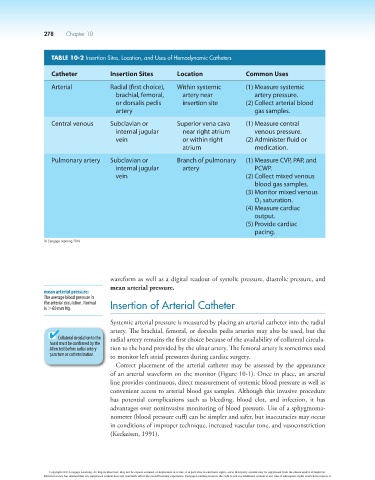
                        TABLE 10-2 Insertion Sites, Location, and Uses of Hemodynamic Catheters

                        Catheter            Insertion Sites      Location               Common Uses

                        Arterial            Radial (first choice),   Within systemic    (1)  Measure systemic
                                             brachial, femoral,    artery near             artery pressure.
                                             or dorsalis pedis     insertion site       (2)  Collect arterial blood
                                             artery                                        gas samples.
                        Central venous      Subclavian or        Superior vena cava     (1)  Measure central
                                             internal jugular      near right atrium       venous pressure.
                                             vein                  or within right      (2)  Administer fluid or
                                                                   atrium                  medication.

                        Pulmonary artery    Subclavian or        Branch of pulmonary    (1)  Measure CVP, PAP, and
                                             internal jugular      artery                  PCWP.
                                             vein                                       (2)  Collect mixed venous
                                                                                           blood gas samples.
                                                                                        (3)  Monitor mixed venous
                                                                                           O  saturation.
                                                                                            2
                                                                                        (4)  Measure cardiac
                                                                                           output.
                                                                                        (5)  Provide cardiac
                                                                                           pacing.
                      © Cengage Learning 2014


                                            waveform as well as a digital readout of systolic pressure, diastolic pressure, and
                                            mean arterial pressure.
                      mean arterial pressure:
                      The average blood pressure in
                      the arterial circulation. Normal    Insertion of Arterial Catheter
                      is .60 mm Hg.

                                            Systemic arterial pressure is measured by placing an arterial catheter into the radial
                                            artery. The brachial, femoral, or dorsalis pedis arteries may also be used, but the
                           Collateral circulation to the   radial artery remains the first choice because of the availability of collateral circula-
                        hand must be confirmed by the
                        Allen test before radial artery   tion to the hand provided by the ulnar artery. The femoral artery is sometimes used
                        puncture or catheterization.  to monitor left atrial pressures during cardiac surgery.
                                             Correct  placement  of  the  arterial  catheter  may  be  assessed  by  the  appearance
                                            of an arterial waveform on the monitor (Figure 10-1). Once in place, an arterial
                                            line provides continuous, direct measurement of systemic blood pressure as well as
                                            convenient access to arterial blood gas samples. Although this invasive procedure
                                            has  potential  complications  such  as  bleeding,  blood  clot,  and  infection,  it  has
                                            advantages over noninvasive monitoring of blood pressure. Use of a sphygmoma-
                                            nometer (blood pressure cuff) can be simpler and safer, but inaccuracies may occur
                                            in conditions of improper technique, increased vascular tone, and vasoconstriction
                                            (Keckeisen, 1991).


                        Copyright 2013 Cengage Learning. All Rights Reserved. May not be copied, scanned, or duplicated, in whole or in part. Due to electronic rights, some third party content may be suppressed from the eBook and/or eChapter(s).
                      Editorial review has deemed that any suppressed content does not materially affect the overall learning experience. Cengage Learning reserves the right to remove additional content at any time if subsequent rights restrictions require it.

