


Page 45 - Clinical Application of Mechanical Ventilation
P. 45
Principles of Mechanical Ventilation  11


                                             Anatomic Deadspace


                                             Normally, the conducting airways contribute to about 30% of deadspace ventila-
                        anatomic deadspace: The
                        volume occupying the conducting   tion. For a tidal volume of 500 mL, about 150 mL of this volume is wasted since it
                        airways that does not take part in   does not take part in gas exchange. This volume in the conducting airways is called
                        gas exchange (estimated to be
                        1 mL/lb ideal body weight).  anatomic deadspace and it can be estimated to be 1 mL/lb of ideal body weight
                                             (Shapiro et al., 1991).
                                               Decrease in tidal volume causes a relatively higher anatomic deadspace to tidal
                            Decrease in tidal volume   volume percent. For example, if the tidal volume was decreased from 500 to 300 mL,
                          causes a relatively higher
                          anatomic deadspace to tidal   the deadspace to tidal volume percent would increase from 30% (150/500) to 50%
                          volume percent.    (150/300) See equations below for comparison:
                                                                        150
                                                                        500  = 0.3 or 30%
                                                                        150  = 0.5 or 50%
                                                                        300
                                             Alveolar Deadspace


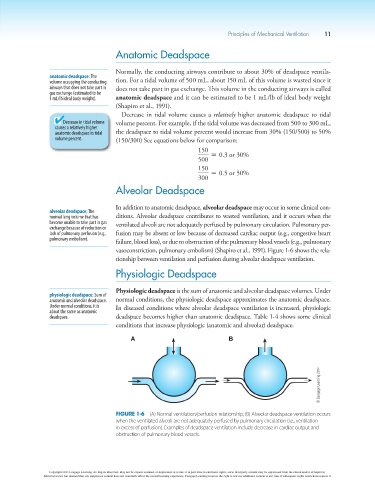
                                             In addition to anatomic deadspace, alveolar deadspace may occur in some clinical con-
                        alveolar deadspace: The
                        normal lung volume that has   ditions. Alveolar deadspace contributes to wasted ventilation, and it occurs when the
                        become unable to take part in gas   ventilated alveoli are not adequately perfused by pulmonary circulation. Pulmonary per-
                        exchange because of reduction or
                        lack of pulmonary perfusion (e.g.,   fusion may be absent or low because of decreased cardiac output (e.g., congestive heart
                        pulmonary embolism).
                                             failure, blood loss), or due to obstruction of the pulmonary blood vessels (e.g., pulmonary
                                             vasoconstriction, pulmonary embolism) (Shapiro et al., 1991). Figure 1-6 shows the rela-
                                             tionship between ventilation and perfusion during alveolar deadspace ventilation.

                                             Physiologic Deadspace

                                             Physiologic deadspace is the sum of anatomic and alveolar deadspace volumes. Under
                        physiologic deadspace: Sum of
                        anatomic and alveolar deadspace.   normal conditions, the physiologic deadspace approximates the anatomic deadspace.
                        Under normal conditions, it is   In diseased conditions where alveolar deadspace ventilation is increased, physiologic
                        about the same as anatomic
                        deadspace.           deadspace becomes higher than anatomic deadspace. Table 1-4 shows some clinical
                                             conditions that increase physiologic (anatomic and alveolar) deadspace.
                                                  A                               B


                                                                                                                © Cengage Learning 2014


                                             Figure 1-6  (A) Normal ventilation/perfusion relationship; (B) Alveolar deadspace ventilation occurs
                                             when the ventilated alveoli are not adequately perfused by pulmonary circulation (i.e., ventilation
                                             in excess of perfusion). Examples of deadspace ventilation include decrease in cardiac output and
                                             obstruction of pulmonary blood vessels.


                        Copyright 2013 Cengage Learning. All Rights Reserved. May not be copied, scanned, or duplicated, in whole or in part. Due to electronic rights, some third party content may be suppressed from the eBook and/or eChapter(s).
                      Editorial review has deemed that any suppressed content does not materially affect the overall learning experience. Cengage Learning reserves the right to remove additional content at any time if subsequent rights restrictions require it.

