


Page 418 - Clinical Application of Mechanical Ventilation
P. 418
384    Chapter 12


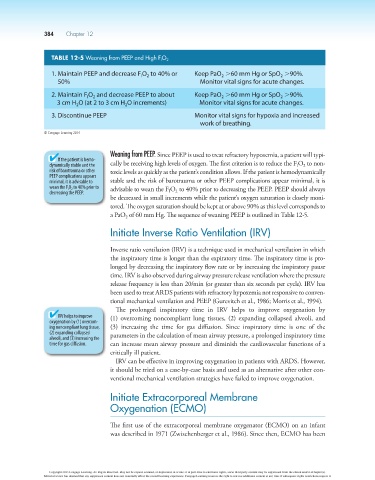
                        TABLE 12-5 Weaning from PEEP and High F I O 2
                        1.  Maintain PEEP and decrease F O  to 40% or   Keep PaO  .60 mm Hg or SpO  .90%.
                                                        2
                                                                                                   2
                                                                                2
                                                      I
                          50%                                            Monitor vital signs for acute changes.
                        2. Maintain F O  and decrease PEEP to about    Keep PaO  .60 mm Hg or SpO  .90%.
                                                                                2
                                                                                                   2
                                    I
                                      2
                          3 cm H O (at 2 to 3 cm H O increments)         Monitor vital signs for acute changes.
                                                2
                                 2
                        3. Discontinue PEEP                            Monitor vital signs for hypoxia and increased
                                                                         work of breathing.
                      © Cengage Learning 2014
                                            Weaning from PEEP.	Since	PEEP	is	used	to	treat	refractory	hypoxemia,	a	patient	will	typi-
                          If the patient is hemo-
                        dynamically stable and the   cally	be	receiving	high	levels	of	oxygen.	The	first	criterion	is	to	reduce	the	F O 	to	non-
                                                                                                        I
                                                                                                           2
                        risk of barotrauma or other   toxic	levels	as	quickly	as	the	patient’s	condition	allows.	If	the	patient	is	hemodynamically
                        PEEP complications appears
                        minimal, it is advisable to   stable	and	the	risk	of	barotrauma	or	other	PEEP	complications	appear	minimal,	it	is
                        wean the F I O 2  to 40% prior to   advisable	to	wean	the	F O 	to	40%	prior	to	decreasing	the	PEEP.	PEEP	should	always
                        decreasing the PEEP.                   I  2
                                            be	decreased	in	small	increments	while	the	patient’s	oxygen	saturation	is	closely	moni-
                                            tored.	The	oxygen	saturation	should	be	kept	at	or	above	90%	as	this	level	corresponds	to
                                            a	PaO 	of	60	mm	Hg.	The	sequence	of	weaning	PEEP	is	outlined	in	Table	12-5.
                                                 2
                                            Initiate Inverse Ratio Ventilation (IRV)


                                            Inverse	ratio	ventilation	(IRV)	is	a	technique	used	in	mechanical	ventilation	in	which
                                            the	inspiratory	time	is	longer	than	the	expiratory	time.	The	inspiratory	time	is	pro-
                                            longed	by	decreasing	the	inspiratory	flow	rate	or	by	increasing	the	inspiratory	pause
                                            time.	IRV	is	also	observed	during	airway	pressure	release	ventilation	where	the	pressure
                                            release	frequency	is	less	than	20/min	(or	greater	than	six	seconds	per	cycle).	IRV	has
                                            been	used	to	treat	ARDS	patients	with	refractory	hypoxemia	not	responsive	to	conven-
                                            tional	mechanical	ventilation	and	PEEP	(Gurevitch	et	al.,	1986;	Morris	et	al.,	1994).
                                             The	 prolonged	 inspiratory	 time	 in	 IRV	 helps	 to	 improve	 oxygenation	 by
                          IRV helps to improve   (1)	overcoming	noncompliant	lung	tissues,	(2)	expanding	collapsed	alveoli,	and
                        oxygenation by (1) overcom-
                        ing noncompliant lung tissue,   (3)	 increasing	 the	 time	 for	 gas	 diffusion.	 Since	 inspiratory	 time	 is	 one	 of	 the
                        (2) expanding collapsed   parameters	in	the	calculation	of	mean	airway	pressure,	a	prolonged	inspiratory	time
                        alveoli, and (3) increasing the
                        time for gas diffusion.  can	increase	mean	airway	pressure	and	diminish	the	cardiovascular	functions	of	a
                                            critically	ill	patient.
                                             IRV	can	be	effective	in	improving	oxygenation	in	patients	with	ARDS.	However,
                                            it	should	be	tried	on	a	case-by-case	basis	and	used	as	an	alternative	after	other	con-
                                            ventional	mechanical	ventilation	strategies	have	failed	to	improve	oxygenation.


                                            Initiate Extracorporeal Membrane
                                            Oxygenation (ECMO)


                                            The	first	use	of	the	extracorporeal	membrane	oxygenator	(ECMO)	on	an	infant
                                            was	described	in	1971	(Zwischenberger	et	al.,	1986).	Since	then,	ECMO	has	been


                        Copyright 2013 Cengage Learning. All Rights Reserved. May not be copied, scanned, or duplicated, in whole or in part. Due to electronic rights, some third party content may be suppressed from the eBook and/or eChapter(s).
                      Editorial review has deemed that any suppressed content does not materially affect the overall learning experience. Cengage Learning reserves the right to remove additional content at any time if subsequent rights restrictions require it.

