


Page 417 - Clinical Application of Mechanical Ventilation
P. 417
Management of Mechanical Ventilation  383


                                             Initiate Continuous Positive Airway
                                             Pressure (CPAP)


                                             Continuous	 positive	 airway	 pressure	 (CPAP)	 provides	 positive	 airway	 pressure
                            CPAP is only suitable for   throughout	the	spontaneous	breathing	cycle.	It	increases	the	functional	residual
                          patients who have adequate
                          respiratory mechanics and can   capacity	and	is	useful	to	correct	hypoxemia	due	to	intrapulmonary	shunting.	Since
                          sustain prolonged spontane-  CPAP	 does	 not	 provide	 mechanical	 ventilation,	 it	 is	 suitable	 only	 for	 patients
                          ous breathing.
                                             who	have	adequate	respiratory	mechanics	and	can	sustain	prolonged	spontaneous
                                             breathing.	Adequacy	of	spontaneous	ventilation	can	be	documented	by	trending	a
                                             patient’s	PaCO .	An	increasing	PaCO 	over	time	indicates	that	the	patient	is	tiring,
                                                          2
                                                                             2
                                             and	continuation	of	CPAP	must	be	reevaluated.
                                             Initiate Positive End-Expiratory Pressure (PEEP)


                                             Positive	end-expiratory	pressure	(PEEP)	provides	positive	airway	pressure	at	the	end
                            CPAP and PEEP increase   of	exhalation	from	a	mechanical	breath.	It	is	similar	to	CPAP	with	the	exception
                          the functional residual
                          capacity and are useful to   that	PEEP	is	used	in	conjunction	with	mechanical	ventilation.	With	PEEP,	sponta-
                          correct hypoxemia due to   neous	breathing	is	not	required	because	the	patient	relies	on	the	ventilator	for	ven-
                          intrapulmonary shunting.
                                             tilatory	support.	Similar	to	CPAP,	PEEP	increases	the	functional	residual	capacity
                                             and	is	therefore	useful	to	correct	hypoxemia	due	to	intrapulmonary	shunting.
                                               In	order	to	minimize	the	cardiovascular	complications	associated	with	excessive
                                             pulmonary	pressures,	the	optimal	PEEP	should	be	used	in	uncomplicated	intra-
                        optimal PEEP: The lowest PEEP
                        level leading to the best oxygen-  pulmonary	shunting	(e.g.,	post-operative	atelectasis).	Optimal	PEEP	may	be	deter-
                        ation status (or other indicators)   mined	by	evaluating	different	parameters,	such	as	PaO ,	compliance,	O 	saturation,
                        without causing significant                                        2             2
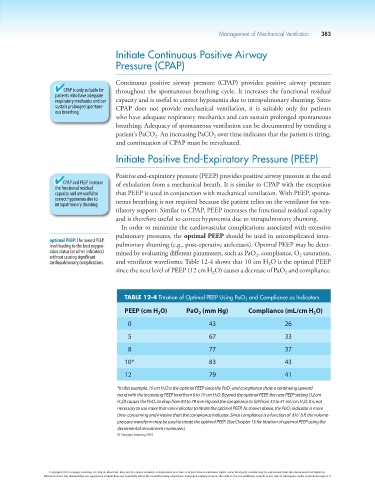
                        cardiopulmonary complications.  and	ventilator	waveforms.	Table	12-4	shows	that	10	cm	H O	is	the	optimal	PEEP
                                                                                               2
                                             since	the	next	level	of	PEEP	(12	cm	H O)	causes	a	decrease	of	PaO 	and	compliance.
                                                                                                     2
                                                                             2

                                                TABLE 12-4 Titration of Optimal PEEP Using PaO 2  and Compliance as Indicators

                                                PEEP (cm H O)       PaO  (mm Hg)         Compliance (mL/cm H O)
                                                                                                              2
                                                           2
                                                                        2
                                                  0                         43                       26
                                                  5                         67                       33
                                                  8                         77                       37

                                                10*                         83                       43

                                                12                          79                       41

                                              *In this example, 10 cm H 2 O is the optimal PEEP since the PaO 2  and compliance show a continuing upward
                                              trend with the increasing PEEP level from 0 to 10 cm H 2 O. Beyond the optimal PEEP, the next PEEP setting (12 cm
                                              H 2 O) causes the PaO 2  to drop from 83 to 79 mm Hg and the compliance to fall from 43 to 41 mL/cm H 2 O. It is not
                                              necessary to use more than one indicator to titrate the optimal PEEP. As shown above, the PaO 2  indicator is more
                                              time-consuming and invasive than the compliance indicator. Since compliance is a function of DV/ DP, the volume-
                                              pressure waveform may be used to titrate the optimal PEEP. (See Chapter 15 for titration of optimal PEEP using the
                                              decremental recruitment maneuver.)
                                              © Cengage Learning 2014


                        Copyright 2013 Cengage Learning. All Rights Reserved. May not be copied, scanned, or duplicated, in whole or in part. Due to electronic rights, some third party content may be suppressed from the eBook and/or eChapter(s).
                      Editorial review has deemed that any suppressed content does not materially affect the overall learning experience. Cengage Learning reserves the right to remove additional content at any time if subsequent rights restrictions require it.

