


Page 440 - Clinical Application of Mechanical Ventilation
P. 440
406    Chapter 12


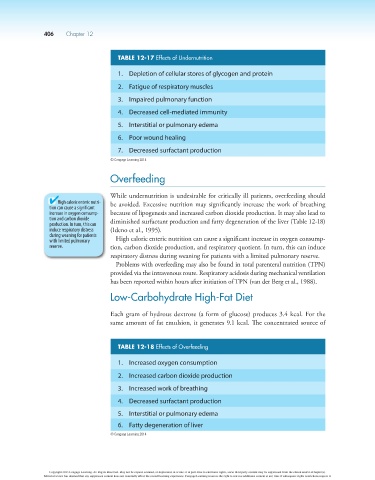
                                              TABLE 12-17 Effects of Undernutrition

                                              1.  Depletion of cellular stores of glycogen and protein

                                              2.  Fatigue of respiratory muscles

                                              3.  Impaired pulmonary function
                                              4.  Decreased cell-mediated immunity

                                              5.  Interstitial or pulmonary edema
                                              6.  Poor wound healing

                                              7.  Decreased surfactant production
                                            © Cengage Learning 2014

                                            Overfeeding


                                            While	undernutrition	is	undesirable	for	critically	ill	patients,	overfeeding	should
                          High caloric enteric nutri-  be	avoided.	Excessive	nutrition	may	significantly	increase	the	work	of	breathing
                        tion can cause a significant
                        increase in oxygen consump-  because	of	lipogenesis	and	increased	carbon	dioxide	production.	It	may	also	lead	to
                        tion and carbon dioxide   diminished	surfactant	production	and	fatty	degeneration	of	the	liver	(Table	12-18)
                        production. In turn, this can
                        induce respiratory distress   (Ideno	et	al.,	1995).
                        during weaning for patients   High	caloric	enteric	nutrition	can	cause	a	significant	increase	in	oxygen	consump-
                        with limited pulmonary
                        reserve.            tion,	carbon	dioxide	production,	and	respiratory	quotient.	In	turn,	this	can	induce
                                            respiratory	distress	during	weaning	for	patients	with	a	limited	pulmonary	reserve.
                                             Problems	with	overfeeding	may	also	be	found	in	total	parenteral	nutrition	(TPN)
                                            provided	via	the	intravenous	route.	Respiratory	acidosis	during	mechanical	ventilation
                                            has	been	reported	within	hours	after	initiation	of	TPN	(van	der	Berg	et	al.,	1988).
                                            Low-Carbohydrate High-Fat Diet


                                            Each	gram	of	hydrous	dextrose	(a	form	of	glucose)	produces	3.4	kcal.	For	the
                                            same	amount	of	fat	emulsion,	it	generates	9.1	kcal.	The	concentrated	source	of


                                              TABLE 12-18 Effects of Overfeeding

                                              1.  Increased oxygen consumption

                                              2.  Increased carbon dioxide production
                                              3.  Increased work of breathing

                                              4.  Decreased surfactant production

                                              5.  Interstitial or pulmonary edema
                                              6.  Fatty degeneration of liver
                                            © Cengage Learning 2014


                        Copyright 2013 Cengage Learning. All Rights Reserved. May not be copied, scanned, or duplicated, in whole or in part. Due to electronic rights, some third party content may be suppressed from the eBook and/or eChapter(s).
                      Editorial review has deemed that any suppressed content does not materially affect the overall learning experience. Cengage Learning reserves the right to remove additional content at any time if subsequent rights restrictions require it.

