


Page 442 - Clinical Application of Mechanical Ventilation
P. 442
408    Chapter 12


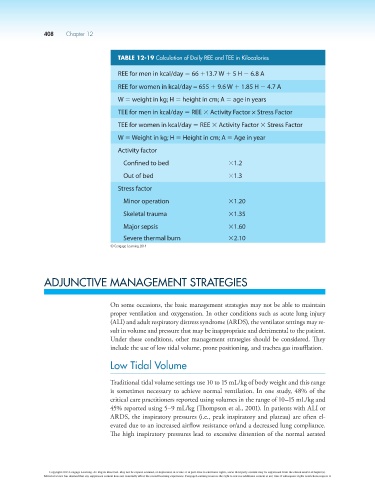
                                              TABLE 12-19 Calculation of Daily REE and TEE in Kilocalories

                                              REE for men in kcal/day 5 66 113.7 W 1 5 H 2 6.8 A

                                              REE for women in kcal/day = 655 1 9.6 W 1 1.85 H 2 4.7 A

                                              W 5 weight in kg; H 5 height in cm; A 5 age in years
                                              TEE for men in kcal/day 5 REE 3 Activity Factor × Stress Factor

                                              TEE for women in kcal/day 5 REE 3 Activity Factor 3 Stress Factor
                                              W 5 Weight in kg; H 5 Height in cm; A 5 Age in year

                                              Activity factor

                                                Confined to bed                   31.2
                                                Out of bed                        31.3

                                              Stress factor
                                                Minor operation                   31.20

                                                Skeletal trauma                   31.35

                                                Major sepsis                      31.60
                                                Severe thermal burn               32.10
                                            © Cengage Learning 2014


                      ADJUNCTIVE MANAGEMENT STRATEGIES


                                            On	some	occasions,	the	basic	management	strategies	may	not	be	able	to	maintain
                                            proper	ventilation	and	oxygenation.	In	other	conditions	such	as	acute	lung	injury
                                            (ALI)	and	adult	respiratory	distress	syndrome	(ARDS),	the	ventilator	settings	may	re-
                                            sult	in	volume	and	pressure	that	may	be	inappropriate	and	detrimental	to	the	patient.
                                            Under	these	conditions,	other	management	strategies	should	be	considered.	They
                                            include	the	use	of	low	tidal	volume,	prone	positioning,	and	trachea	gas	insufflation.

                                            Low Tidal Volume


                                            Traditional	tidal	volume	settings	use	10	to	15	mL/kg	of	body	weight	and	this	range
                                            is	sometimes	necessary	to	achieve	normal	ventilation.	In	one	study,	48%	of	the
                                            critical	care	practitioners	reported	using	volumes	in	the	range	of	10–15	mL/kg	and
                                            45%	reported	using	5–9	mL/kg	(Thompson	et	al.,	2001).	In	patients	with	ALI	or
                                            ARDS,	the	inspiratory	pressures	(i.e.,	peak	inspiratory	and	plateau)	are	often	el-
                                            evated	due	to	an	increased	airflow	resistance	or/and	a	decreased	lung	compliance.
                                            The	high	inspiratory	pressures	lead	to	excessive	distention	of	the	normal	aerated


                        Copyright 2013 Cengage Learning. All Rights Reserved. May not be copied, scanned, or duplicated, in whole or in part. Due to electronic rights, some third party content may be suppressed from the eBook and/or eChapter(s).
                      Editorial review has deemed that any suppressed content does not materially affect the overall learning experience. Cengage Learning reserves the right to remove additional content at any time if subsequent rights restrictions require it.

