


Page 460 - Clinical Application of Mechanical Ventilation
P. 460
426    Chapter 13


                                            Special Considerations. The primary purpose of beta agonists is bronchodilation. For
                                            patients with inflammatory airway disease (i.e., asthma and chronic bronchitis),
                                            intermittent use of beta agonists may not be sufficient. Deaths have been reported
                                            in asthmatics following regular and prolonged use of these agents. Uncontrolled
                                            inflammation  and  mucosal  edema  are  likely  the  cause  of  this  adverse  outcome
                                            (Witek, 1994).
                                             Desensitization of receptor sites has been documented with regular use of beta
                                            agonists. Two mechanisms appear to be responsible: (1) the loss of receptor from
                                            the surface of cells and (2) the failure of the cell to function (Cottrell et al., 1995).
                                            The practitioner may wish to combine beta agonists with other categories of drugs
                                            to achieve bronchodilation. For example, a combination of corticosteroid and beta
                                            agonist may potentiate their individual effects and produce bronchodilation.
                                             However, paradoxical bronchospasm may occur with combined use of adrenergic
                                            agonists and corticosteroids. Its occurrence is rare, but the onset can be sudden. For
                                            this reason, practitioners should be aware of the hazard.

                                            Anticholinergic Bronchodilators
                      acetylcholine: An ester that
                      plays a role in the transmission   (Parasympatholytics)
                      of nerve impulses at synapses
                      and neuromuscular junctions.
                      It is metabolized by an enzyme,   Anticholinergic bronchodilators are agents that impede the impulses of the cholin-
                      cholinesterase. Too much or too
                      little of acetylcholine at the motor   ergic, especially the parasympathetic nerve fibers of the autonomic nervous system.
                      endplates may lead to muscle
                      blockade.             Mechanism  of  Action.  Parasympathetic  receptors  (muscarinic  and  nicotinic)  are
                                            found throughout the body. They are classified according to whether they respond
                                            to muscarine or nicotine. In the lungs, muscarinic receptors are found in submuco-
                          Atropine is an anti-  sal glands, mast cells, and smooth muscles of the larger airways.
                        cholinergic agent used as a   The combination of acetylcholine with muscarinic receptors results in increased
                        secondary bronchodilator. It
                        is also used for symptomatic   bronchial tone and increased secretion from mucosal glands. Anticholinergic agents
                        bradycardia and prophylactic   (atropine and atropine derivatives) block these physiologic responses and may be
                        drying of secretions before
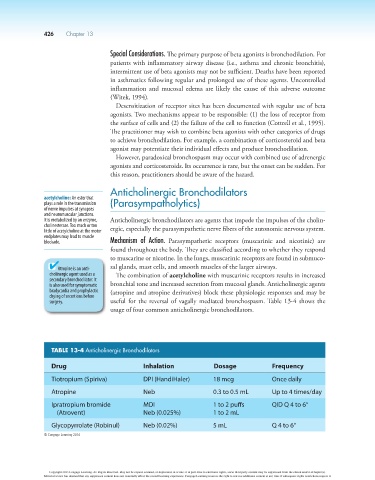
                        surgery.            useful for the reversal of vagally mediated bronchospasm. Table 13-4 shows the
                                            usage of four common anticholinergic bronchodilators.


                        TABLE 13-4 Anticholinergic Bronchodilators

                        Drug                          Inhalation               Dosage           Frequency

                        Tiotropium (Spiriva)          DPI (HandiHaler)       18 mcg             Once daily
                        Atropine                      Neb                    0.3 to 0.5 mL      Up to 4 times/day

                        Ipratropium bromide           MDI                    1 to 2 puffs       QID Q 4 to 6°
                          (Atrovent)                  Neb (0.025%)           1 to 2 mL
                        Glycopyrrolate (Robinul)      Neb (0.02%)            5 mL               Q 4 to 6°
                      © Cengage Learning 2014


                        Copyright 2013 Cengage Learning. All Rights Reserved. May not be copied, scanned, or duplicated, in whole or in part. Due to electronic rights, some third party content may be suppressed from the eBook and/or eChapter(s).
                      Editorial review has deemed that any suppressed content does not materially affect the overall learning experience. Cengage Learning reserves the right to remove additional content at any time if subsequent rights restrictions require it.

