


Page 462 - Clinical Application of Mechanical Ventilation
P. 462
428    Chapter 13


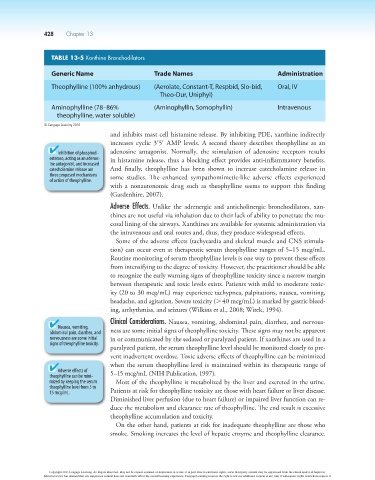
                        TABLE 13-5 Xanthine Bronchodilators

                        Generic Name                      Trade Names                             Administration

                        Theophylline (100% anhydrous)     (Aerolate, Constant-T, Respbid, Slo-bid,   Oral, IV
                                                            Theo-Dur, Uniphyl)
                        Aminophylline (78–86%             (Aminophyllin, Somophyllin)             Intravenous
                          theophylline, water soluble)
                      © Cengage Learning 2014
                                            and inhibits mast cell histamine release. By inhibiting PDE, xanthine indirectly
                                            increases  cyclic  3′5′  AMP  levels.  A  second  theory  describes  theophylline  as  an

                          Inhibition of phosphodi-  adenosine  antagonist.  Normally,  the  stimulation  of  adenosine  receptors  results
                        esterase, acting as an adenos-  in histamine release, thus a blocking effect provides anti-inflammatory benefits.
                        ine antagonist, and increased
                        catecholamine release are   And  finally,  theophylline  has  been  shown  to  increase  catecholamine  release  in
                        three proposed mechanisms   some  studies.  The  enhanced  sympathomimetic-like  adverse  effects  experienced
                        of action of theophylline.
                                            with  a  nonautonomic  drug  such  as  theophylline  seems  to  support  this  finding
                                            (Gardenhire, 2007).
                                            Adverse Effects.  Unlike  the  adrenergic  and  anticholinergic  bronchodilators,  xan-
                                            thines are not useful via inhalation due to their lack of ability to penetrate the mu-
                                            cosal lining of the airways. Xanthines are available for systemic administration via
                                            the intravenous and oral routes and, thus, they produce widespread effects.
                                             Some of the adverse effects (tachycardia and skeletal muscle and CNS stimula-
                                            tion) can occur even at therapeutic serum theophylline ranges of 5–15 mcg/mL.
                                            Routine monitoring of serum theophylline levels is one way to prevent these effects
                                            from intensifying to the degree of toxicity. However, the practitioner should be able
                                            to recognize the early warning signs of theophylline toxicity since a narrow margin
                                            between therapeutic and toxic levels exists. Patients with mild to moderate toxic-
                                            ity (20 to 30 mcg/mL) may experience tachypnea, palpitations, nausea, vomiting,
                                            headache, and agitation. Severe toxicity (. 40 mcg/mL) is marked by gastric bleed-
                                            ing, arrhythmias, and seizures (Wilkins et al., 2008; Witek, 1994).

                                            Clinical Considerations. Nausea, vomiting, abdominal pain, diarrhea, and nervous-
                           Nausea, vomiting,
                        abdominal pain, diarrhea, and   ness are some initial signs of theophylline toxicity. These signs may not be apparent
                        nervousness are some initial   in or communicated by the sedated or paralyzed patient. If xanthines are used in a
                        signs of theophylline toxicity.
                                            paralyzed patient, the serum theophylline level should be monitored closely to pre-
                                            vent inadvertent overdose. Toxic adverse effects of theophylline can be minimized
                                            when the serum theophylline level is maintained within its therapeutic range of
                          Adverse effects of   5–15 mcg/mL (NIH Publication, 1997).
                        theophylline can be mini-
                        mized by keeping the serum   Most of the theophylline is metabolized by the liver and excreted in the urine.
                        theophylline level from 5 to
                        15 mcg/mL.          Patients at risk for theophylline toxicity are those with heart failure or liver disease.
                                            Diminished liver perfusion (due to heart failure) or impaired liver function can re-
                                            duce the metabolism and clearance rate of theophylline. The end result is excessive
                                            theophylline accumulation and toxicity.
                                             On the other hand, patients at risk for inadequate theophylline are those who
                                            smoke. Smoking increases the level of hepatic enzyme and theophylline clearance.


                        Copyright 2013 Cengage Learning. All Rights Reserved. May not be copied, scanned, or duplicated, in whole or in part. Due to electronic rights, some third party content may be suppressed from the eBook and/or eChapter(s).
                      Editorial review has deemed that any suppressed content does not materially affect the overall learning experience. Cengage Learning reserves the right to remove additional content at any time if subsequent rights restrictions require it.

