


Page 464 - Clinical Application of Mechanical Ventilation
P. 464
430    Chapter 13


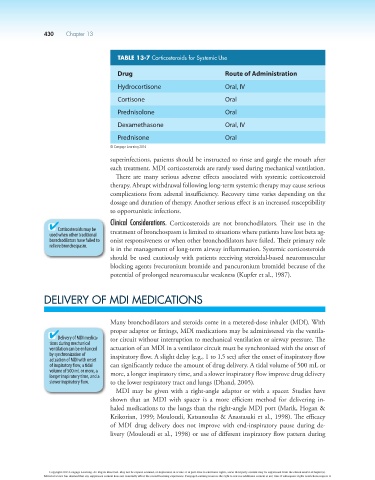
                                              TABLE 13-7 Corticosteroids for Systemic Use

                                              Drug                               Route of Administration

                                              Hydrocortisone                     Oral, IV

                                              Cortisone                          Oral
                                              Prednisolone                       Oral

                                              Dexamethasone                      Oral, IV
                                              Prednisone                         Oral

                                            © Cengage Learning 2014
                                            superinfections, patients should be instructed to rinse and gargle the mouth after
                                            each treatment. MDI corticosteroids are rarely used during mechanical ventilation.
                                             There  are  many  serious  adverse  effects  associated  with  systemic  corticosteroid
                                            therapy. Abrupt withdrawal following long-term systemic therapy may cause serious
                                            complications from adrenal insufficiency. Recovery time varies depending on the
                                            dosage and duration of therapy. Another serious effect is an increased susceptibility
                                            to opportunistic infections.

                                            Clinical  Considerations.  Corticosteroids  are  not  bronchodilators.  Their  use  in  the
                          Corticosteroids may be   treatment of bronchospasm is limited to situations where patients have lost beta ag-
                        used when other traditional
                        bronchodilators have failed to   onist responsiveness or when other bronchodilators have failed. Their primary role
                        relieve bronchospasm.  is in the management of long-term airway inflammation. Systemic corticosteroids
                                            should be used cautiously with patients receiving steroidal-based neuromuscular
                                            blocking agents (vecuronium bromide and pancuronium bromide) because of the
                                            potential of prolonged neuromuscular weakness (Kupfer et al., 1987).


                      DELIVERy OF MDI MEDICATIONS


                                            Many bronchodilators and steroids come in a metered-dose inhaler (MDI). With
                                            proper adaptor or fittings, MDI medications may be administered via the ventila-
                          Delivery of MDI medica-  tor circuit without interruption to mechanical ventilation or airway pressure. The
                        tions during mechanical
                        ventilation can be enhanced   actuation of an MDI in a ventilator circuit must be synchronized with the onset of
                        by synchronization of   inspiratory flow. A slight delay (e.g., 1 to 1.5 sec) after the onset of inspiratory flow
                        actuation of MDI with onset
                        of inspiratory flow, a tidal   can significantly reduce the amount of drug delivery. A tidal volume of 500 mL or
                        volume of 500 mL or more, a   more, a longer inspiratory time, and a slower inspiratory flow improve drug delivery
                        longer inspiratory time, and a
                        slower inspiratory flow.  to the lower respiratory tract and lungs (Dhand, 2005).
                                             MDI may be given with a right-angle adaptor or with a spacer. Studies have
                                            shown  that  an  MDI  with  spacer  is  a  more  efficient  method  for  delivering  in-
                                            haled medications to the lungs than the right-angle MDI port (Marik, Hogan &
                                            Krikorian, 1999; Mouloudi, Katsanoulas & Anastasaki et al., 1998). The efficacy
                                            of  MDI  drug  delivery  does  not  improve  with  end-inspiratory  pause  during  de-
                                            livery (Mouloudi et al., 1998) or use of different inspiratory flow pattern during


                        Copyright 2013 Cengage Learning. All Rights Reserved. May not be copied, scanned, or duplicated, in whole or in part. Due to electronic rights, some third party content may be suppressed from the eBook and/or eChapter(s).
                      Editorial review has deemed that any suppressed content does not materially affect the overall learning experience. Cengage Learning reserves the right to remove additional content at any time if subsequent rights restrictions require it.

