


Page 463 - Clinical Application of Mechanical Ventilation
P. 463
Pharmacotherapy for Mechanical Ventilation  429


                                             The end result for these individuals is higher maintenance theophylline dosages to
                                             maintain bronchodilation (Cottrell et al., 1995).

                                             Anti-Inflammatory Agents (Corticosteroids)


                                             In addition to the drugs that exert their bronchodilation effects using the pathways
                        corticosteroids: Hormones that   in the autonomic nervous system, corticosteroids are a different group of drugs that
                        are released from the cortex of   are useful in the management of bronchoconstriction and airflow obstruction due to
                        the adrenal gland. Their potent
                        anti-inflammatory effects make   airway inflammation. Corticosteroids are powerful, naturally occurring hormones
                        corticosteroids useful in the treat-
                        ment of asthma and chronic bron-  that are released from the adrenal cortex. Their anti-inflammatory effects make them
                        chitis. Corticosteroids are available   first-line drugs in the management of chronic asthma and other long-term airway
                        for intravenous administration as
                        well as inhalation. Examples of   inflammatory conditions. In the intensive care setting, they have been used with
                        inhaled steroids are dexametha-  favorable results in status asthmaticus, acute exacerbation of COPD, inhalation air-
                        sone (Decadron, Respihaler),
                        beclomethasone (Beclovent,   way injury, drug-induced pneumonitis, septic shock, ARDS, and spinal cord injury.
                        Vanceril), flunisolide (AeroBid),   Corticosteroids have no bronchodilator effect and should not be given alone during
                        and triamcinolone (Azmacort).
                                             an acute asthma attack. The effects of corticosteroids require an onset time of about
                                             2 to 24 hours, further demonstrating their inappropriateness in acute situations.
                                             Mechanism of Action. The general functions of corticosteroids include (1) carbohy-
                                             drate metabolism, (2) immunosuppression, and (3) reduced inflammation. Their
                                             specific mechanism in reducing inflammation is complex, involving genetic changes
                                             to target cells of inflammation. The combination of the steroid with its receptor site
                                             (nucleus of target cell) results in altered cellular function.
                                               Normally, an inflammatory response results in the release of histamine and bra-
                            Corticosteroids return   dykinin (among other mediators) from the mast cell, causing bronchoconstriction
                          constricted airways to normal
                          by blocking the inflammatory   and increased capillary permeability. This leads to early-phase bronchoconstriction
                          mediators.         and late-phase submucosal edema and hyperactivity (Gardenhire, 2007). With al-
                                             tered cellular function, these and other mediators are blocked and inflammation is
                                             reduced.
                                             Adverse Effects. Corticosteroids are available for oral, intravenous, and inhalation
                                             administration (Tables 13-6 and 13-7), and, as with most agents, the inhalation
                                             route is favored for its convenience, smaller dosage, and fewer adverse effects.
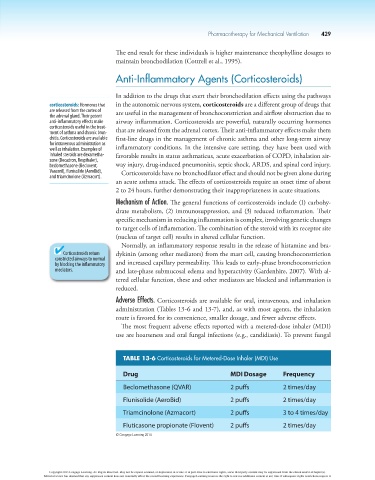
                                               The most frequent adverse effects reported with a metered-dose inhaler (MDI)
                                             use are hoarseness and oral fungal infections (e.g., candidiasis). To prevent fungal


                                                TABLE 13-6 Corticosteroids for Metered-Dose Inhaler (MDI) Use


                                                Drug                               MDI Dosage       Frequency
                                                Beclomethasone (QVAR)              2 puffs          2 times/day

                                                Flunisolide (AeroBid)              2 puffs          2 times/day

                                                Triamcinolone (Azmacort)           2 puffs          3 to 4 times/day
                                                Fluticasone propionate (Flovent)   2 puffs          2 times/day
                                             © Cengage Learning 2014


                        Copyright 2013 Cengage Learning. All Rights Reserved. May not be copied, scanned, or duplicated, in whole or in part. Due to electronic rights, some third party content may be suppressed from the eBook and/or eChapter(s).
                      Editorial review has deemed that any suppressed content does not materially affect the overall learning experience. Cengage Learning reserves the right to remove additional content at any time if subsequent rights restrictions require it.

