


Page 478 - Clinical Application of Mechanical Ventilation
P. 478
444    Chapter 13


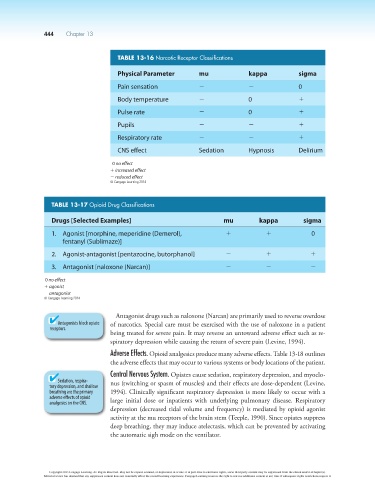
                                              TABLE 13-16 Narcotic Receptor Classifications

                                              Physical Parameter         mu              kappa           sigma

                                              Pain sensation             2               2               0

                                              Body temperature           2               0               1
                                              Pulse rate                 2               0               1

                                              Pupils                     2               2               1
                                              Respiratory rate           2               2               1

                                              CNS effect                 Sedation        Hypnosis        Delirium

                                              0 no effect
                                            1 increased effect
                                            2 reduced effect
                                            © Cengage Learning 2014


                        TABLE 13-17 Opioid Drug Classifications

                        Drugs [Selected Examples]                                mu         kappa          sigma

                        1.   Agonist [morphine, meperidine (Demerol),            1            1              0
                            fentanyl (Sublimaze)]
                        2.  Agonist-antagonist [pentazocine, butorphanol]        2            1              1

                        3.  Antagonist [naloxone (Narcan)]                       2            2              2

                       0 no effect
                      1 agonist
                      2 antagonist
                      © Cengage Learning 2014


                                             Antagonist drugs such as naloxone (Narcan) are primarily used to reverse overdose
                           Antagonists block opiate   of narcotics. Special care must be exercised with the use of naloxone in a patient
                        receptors.
                                            being treated for severe pain. It may reverse an untoward adverse effect such as re-
                                            spiratory depression while causing the return of severe pain (Levine, 1994).
                                            Adverse Effects. Opioid analgesics produce many adverse effects. Table 13-18 outlines
                                            the adverse effects that may occur to various systems or body locations of the patient.

                                            Central Nervous System. Opiates cause sedation, respiratory depression, and myoclo-
                          Sedation, respira-  nus (twitching or spasm of muscles) and their effects are dose-dependent (Levine,
                        tory depression, and shallow
                        breathing are the primary   1994). Clinically significant respiratory depression is more likely to occur with a
                        adverse effects of opioid   large  initial  dose  or  inpatients  with  underlying  pulmonary  disease.  Respiratory
                        analgesics on the CNS.
                                            depression (decreased tidal volume and frequency) is mediated by opioid agonist
                                            activity at the mu receptors of the brain stem (Teeple, 1990). Since opiates suppress
                                            deep breathing, they may induce atelectasis, which can be prevented by activating
                                            the automatic sigh mode on the ventilator.


                        Copyright 2013 Cengage Learning. All Rights Reserved. May not be copied, scanned, or duplicated, in whole or in part. Due to electronic rights, some third party content may be suppressed from the eBook and/or eChapter(s).
                      Editorial review has deemed that any suppressed content does not materially affect the overall learning experience. Cengage Learning reserves the right to remove additional content at any time if subsequent rights restrictions require it.

