


Page 474 - Clinical Application of Mechanical Ventilation
P. 474
440    Chapter 13


                                            Sedatives and Antianxiety Agents
                                            (Benzodiazepines)


                                            Benzodiazepines are given to patients to reduce anxiety, provide amnesia, and improve
                      benzodiazepines: A group of
                      drugs with strong hypnotic and   tolerance of mechanical ventilation. In addition, they facilitate invasive procedures (e.g.,
                      sedative actions; used mainly   bronchoscopy, intravenous access, suctioning), decrease oxygen consumption, and pro-
                      to reduce anxiety and to induce
                      sleep.                tect the patient from self-injury.
                                            Mechanism of Action. Binding receptors for benzodiazepines have been identified
                                            in the limbic, thalamic, and hypothalamic levels of the central nervous system
                                            (Mohler et al., 1977). These receptor sites appear to be involved in a large molecular
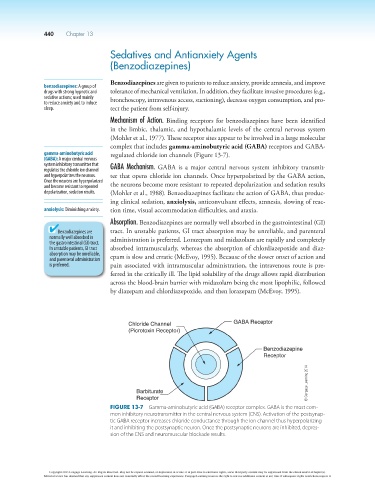
                                            complex that includes gamma-aminobutyric acid (GABA) receptors and GABA-
                      gamma-aminobutyric acid   regulated chloride ion channels (Figure 13-7).
                      (GABA): A major central nervous
                      system inhibitory transmitter that   GABA Mechanism. GABA  is  a  major  central  nervous  system  inhibitory  transmit-
                      regulates the chloride ion channel
                      and hyperpolarizes the neurons.   ter that opens chloride ion channels. Once hyperpolarized by the GABA action,
                      Once the neurons are hyperpolarized
                      and become resistant to repeated   the neurons become more resistant to repeated depolarization and sedation results
                      depolarization, sedation results.  (Mohler et al., 1988). Benzodiazepines facilitate the action of GABA, thus produc-
                                            ing clinical sedation, anxiolysis, anticonvulsant effects, amnesia, slowing of reac-
                      anxiolysis: Diminishing anxiety.  tion time, visual accommodation difficulties, and ataxia.

                                            Absorption. Benzodiazepines are normally well absorbed in the gastrointestinal (GI)
                          Benzodiazepines are   tract. In unstable patients, GI tract absorption may be unreliable, and parenteral
                        normally well absorbed in   administration is preferred. Lorazepam and midazolam are rapidly and completely
                        the gastrointestinal (GI) tract.
                        In unstable patients, GI tract   absorbed intramuscularly, whereas the absorption of chlordiazepoxide and diaz-
                        absorption may be unreliable,   epam is slow and erratic (McEvoy, 1995). Because of the slower onset of action and
                        and parenteral administration
                        is preferred.       pain associated with intramuscular administration, the intravenous route is pre-
                                            ferred in the critically ill. The lipid solubility of the drugs allows rapid distribution
                                            across the blood-brain barrier with midazolam being the most lipophilic, followed
                                            by diazepam and chlordiazepoxide, and then lorazepam (McEvoy, 1995).


                                                  Chloride Channel                  GABA Receptor
                                                  (Picrotoxin Receptor)


                                                                                              Benzodiazepine
                                                                                              Receptor

                                                                                                            © Cengage Learning 2014


                                                    Barbiturate
                                                    Receptor
                                            Figure 13-7  Gamma-aminobutyric acid (GABA) receptor complex. GABA is the most com-
                                            mon inhibitory neurotransmitter in the central nervous system (CNS). Activation of the postsynap-
                                            tic GABA receptor increases chloride conductance through the ion channel thus hyperpolarizing
                                            it and inhibiting the postsynaptic neuron. Once the postsynaptic neurons are inhibited, depres-
                                            sion of the CNS and neuromuscular blockade results.


                        Copyright 2013 Cengage Learning. All Rights Reserved. May not be copied, scanned, or duplicated, in whole or in part. Due to electronic rights, some third party content may be suppressed from the eBook and/or eChapter(s).
                      Editorial review has deemed that any suppressed content does not materially affect the overall learning experience. Cengage Learning reserves the right to remove additional content at any time if subsequent rights restrictions require it.

