


Page 473 - Clinical Application of Mechanical Ventilation
P. 473
Pharmacotherapy for Mechanical Ventilation  439


                        CENTRAL NERVOUS SySTEM AGENTS


                                             Medications that act on the central nervous system are often categorized by
                                             their primary effect, but this can create problems when the substance has mul-
                                             tiple effects (which is the case for many). It is less confusing to categorize a drug
                                             by its composition rather than by one of its therapeutic effects. For instance, a
                                             benzodiazepine can produce sedation to the point of sleep (hypnotic sedative),
                                             anxiety relief (anxiolytic), amnesia, muscle relaxation, and relief from seizures.
                                             Ketamine is an unusual drug in that it has both analgesic and sedation prop-
                                             erties.  Common  terms  for  central  nervous  system  effects  include  anesthesia
                                             (diminished bodily sensation), analgesia (relief of pain), sedation (diminished
                                             awareness  or  consciousness),  and  neurolepsis  (a  particular  alteration  of  con-
                                             sciousness that produces reduced anxiety, calming, and indifference to one’s
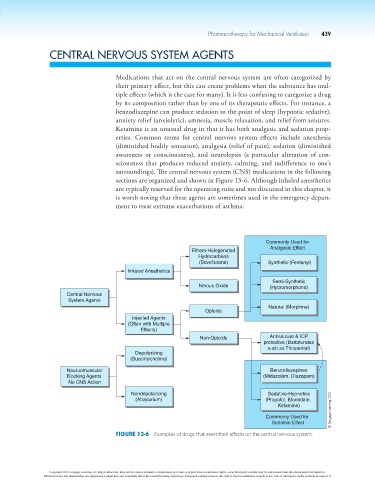
                                             surroundings). The central nervous system (CNS) medications in the following
                                             sections are organized and shown in Figure 13-6. Although inhaled anesthetics
                                             are typically reserved for the operating suite and not discussed in this chapter, it
                                             is worth noting that these agents are sometimes used in the emergency depart-
                                             ment to treat extreme exacerbations of asthma.


                                                                                              Commonly Used for
                                                                                                Analgesic Effect
                                                                      Ethers-Halogenated
                                                                        Hydrocarbons
                                                                         (Sevoflurane)         Synthetic (Fentanyl)
                                                 Inhaled Anesthetics
                                                                                                 Semi-Synthetic
                                                                        Nitrous Oxide           (Hydromorphone)
                             Central Nervous
                              System Agents
                                                                                               Natural (Morphine)
                                                                           Opioids
                                                   Injected Agents
                                                 (Often with Multiple
                                                      Effects)
                                                                         Non-Opioids            Antiseizure & ICP
                                                                                              protective (Barbiturates
                                                                                               such as Thiopental)
                                                    Depolarizing
                                                  (Succinylcholine)
                             Neuruomuscular                                                     Benzodiazepines
                             Blocking Agents                                                 (Midazolam, Diazepam)
                              No CNS Action

                                                  Nondepolarizing                              Sedative-Hypnotics
                                                    (Atracurium)                              (Propofol, Etomidate,
                                                                                                  Ketamine)         © Cengage Learning 2014
                                                                                              Commonly Used for
                                                                                                Sedative Effect
                                             Figure 13-6  Examples of drugs that exert their effects on the central nervous system.


                        Copyright 2013 Cengage Learning. All Rights Reserved. May not be copied, scanned, or duplicated, in whole or in part. Due to electronic rights, some third party content may be suppressed from the eBook and/or eChapter(s).
                      Editorial review has deemed that any suppressed content does not materially affect the overall learning experience. Cengage Learning reserves the right to remove additional content at any time if subsequent rights restrictions require it.

