


Page 497 - Clinical Application of Mechanical Ventilation
P. 497
Procedures Related to Mechanical Ventilation  463


                                             Indications for Chest Tube


                                             Common indications for chest tube include large pneumothorax (.25%), hemotho-
                            Common indications   rax, and pleural effusion. Causes of pneumothorax include positive pressure ventilation,
                          for chest tube include large
                          pneumothorax (.25%),   ruptured bleb due to emphysema, bronchopleural fistula, leaking subpleural cyst, and
                          hemothorax, and pleural   chest trauma. Iatrogenic pneumothorax may be caused by invasive procedures such
                          effusion.
                                             as  thoracentesis,  central  vein/pulmonary  artery  catheterization,  and  bronchoscopy/
                                             transbronchial biopsy (Chen et al., 2002). Excessive pleural fluid may be caused by tho-
                                             racic trauma (hemothorax), heart failure (pleural effusion), intra-abdominal infection
                            Potential complications
                          of chest tube placement   (empyema), and blockage of lymphatic system (chylothorax) (Irwin et al., 2003).
                          include hemorrhage at
                          insertion site, hematoma,   Contraindications and Complications. There are no absolute contraindications to chest
                          laceration of lung parenchyma   tube  placement  in  patients  who  are  symptomatic  from  the  above  indications.
                          or intra-abdominal organs,
                          and infection.     Relative contraindications include infection over the insertion site, and conditions
                                             that may lead to severe bleeding during chest tube placement (Thomas, 2004).
                                               Potential complications of chest tube placement include hemorrhage at the inser-
                                             tion site, hematoma, and laceration of lung parenchyma or intra-abdominal organs.
                            The suggested chest tube
                          size for teens and large adults   Infection can be a late complication (Thomas, 2004).
                          ranges from 28 to 40 Fr.
                                             Chest Tube Selection and Placement


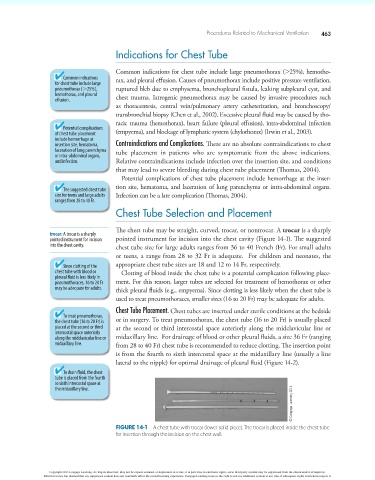
                                             The chest tube may be straight, curved, trocar, or nontrocar. A trocar is a sharply
                        trocar: A trocar is a sharply
                        pointed instrument for incision   pointed instrument for incision into the chest cavity (Figure 14-1). The suggested
                        into the chest cavity.  chest tube size for large adults ranges from 36 to 40 French (Fr). For small adults

                                             or teens, a range from 28 to 32 Fr is adequate.  For children and neonates, the
                            Since clotting of the   appropriate chest tube sizes are 18 and 12 to 14 Fr, respectively.
                          chest tube with blood or   Clotting of blood inside the chest tube is a potential complication following place-
                          pleural fluid is less likely in
                          pneumothoraces, 16 to 20 Fr   ment. For this reason, larger tubes are selected for treatment of hemothorax or other
                          may be adequate for adults.  thick pleural fluids (e.g., empyema). Since clotting is less likely when the chest tube is
                                             used to treat pneumothoraces, smaller sizes (16 to 20 Fr) may be adequate for adults.

                                             Chest Tube Placement. Chest tubes are inserted under sterile conditions at the bedside
                            To treat pneumothorax,
                          the chest tube (16 to 20 Fr) is   or in surgery. To treat pneumothorax, the chest tube (16 to 20 Fr) is usually placed
                          placed at the second or third   at the second or third intercostal space anteriorly along the midclavicular line or
                          intercostal space anteriorly
                          along the midclavicular line or   midaxillary line.  For drainage of blood or other pleural fluids, a size 36 Fr (ranging
                          midaxillary line.  from 28 to 40 Fr) chest tube is recommended to reduce clotting. The insertion point
                                             is from the fourth to sixth intercostal space at the midaxillary line (usually a line
                                             lateral to the nipple) for optimal drainage of pleural fluid (Figure 14-2).
                            To drain fluid, the chest
                          tube is placed from the fourth
                          to sixth intercostal space at
                                                                                                       © Cengage Learning 2014
                          the midaxillary line.


                                             Figure 14-1  A chest tube with trocar (lower solid piece). The trocar is placed inside the chest tube
                                             for insertion through the incision on the chest wall.


                        Copyright 2013 Cengage Learning. All Rights Reserved. May not be copied, scanned, or duplicated, in whole or in part. Due to electronic rights, some third party content may be suppressed from the eBook and/or eChapter(s).
                      Editorial review has deemed that any suppressed content does not materially affect the overall learning experience. Cengage Learning reserves the right to remove additional content at any time if subsequent rights restrictions require it.

