


Page 499 - Clinical Application of Mechanical Ventilation
P. 499
Procedures Related to Mechanical Ventilation  465


                                             Methods of Placement


                                             Operative  tube  thoracostomy  and  trocar  tube  thoracostomy  are  two  common
                                             methods to perform chest tube placement. Each method has its advantages and
                                             disadvantages (Deshpande et al., 2002).

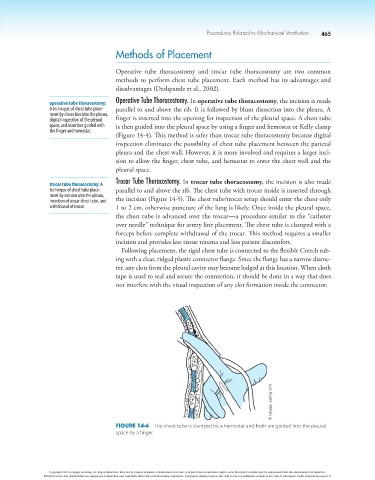
                        operative tube thoracostomy:   Operative Tube Thoracostomy. In operative tube thoracostomy, the incision is made
                        A technique of chest tube place-  parallel to and above the rib. It is followed by blunt dissection into the pleura. A
                        ment by dissection into the pleura,
                        digital inspection of the pleural   finger is inserted into the opening for inspection of the pleural space. A chest tube
                        space, and insertion guided with   is then guided into the pleural space by using a finger and hemostat or Kelly clamp
                        the finger and hemostat.
                                             (Figure 14-4). This method is safer than trocar tube thoracostomy because digital
                                             inspection eliminates the possibility of chest tube placement between the parietal
                                             pleura and the chest wall. However, it is more involved and requires a larger inci-
                                             sion to allow the finger, chest tube, and hemostat to enter the chest wall and the
                                             pleural space.

                        trocar tube thoracostomy: A   Trocar Tube Thoracostomy. In trocar tube thoracostomy, the incision is also made
                        technique of chest tube place-  parallel to and above the rib. The chest tube with trocar inside is inserted through
                        ment by incision into the pleura,
                        insertion of trocar chest tube, and   the incision (Figure 14-5). The chest tube/trocar setup should enter the chest only
                        withdrawal of trocar.   1 to 2 cm, otherwise puncture of the lung is likely. Once inside the pleural space,
                                             the chest tube is advanced over the trocar—a procedure similar to the “catheter
                                             over needle” technique for artery line placement. The chest tube is clamped with a
                                             forceps before complete withdrawal of the trocar. This method requires a smaller
                                             incision and provides less tissue trauma and less patient discomfort.
                                               Following placement, the rigid chest tube is connected to the flexible Creech tub-
                                             ing with a clear, ridged plastic connector flange. Since the flange has a narrow diame-
                                             ter, any clots from the pleural cavity may become lodged at this location. When cloth
                                             tape is used to seal and secure the connection, it should be done in a way that does
                                             not interfere with the visual inspection of any clot formation inside the connector.


                                                                                                © Cengage Learning 2014


                                             Figure 14-4  The chest tube is clamped by a hemostat and both are guided into the pleural
                                             space by a finger.


                        Copyright 2013 Cengage Learning. All Rights Reserved. May not be copied, scanned, or duplicated, in whole or in part. Due to electronic rights, some third party content may be suppressed from the eBook and/or eChapter(s).
                      Editorial review has deemed that any suppressed content does not materially affect the overall learning experience. Cengage Learning reserves the right to remove additional content at any time if subsequent rights restrictions require it.

