


Page 500 - Clinical Application of Mechanical Ventilation
P. 500
466    Chapter 14


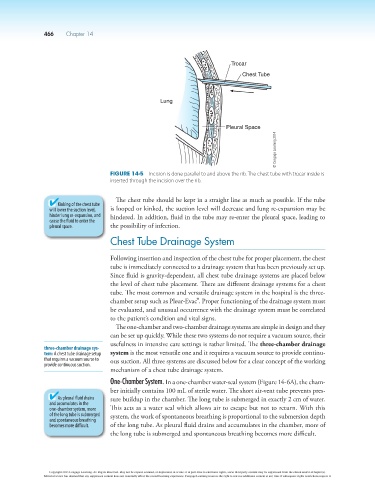
                                                                                   Trocar

                                                                                       Chest Tube


                                                            Lung


                                                                                 Pleural Space
                                                                                                  © Cengage Learning 2014


                                            Figure 14-5  Incision is done parallel to and above the rib. The chest tube with trocar inside is
                                            inserted through the incision over the rib.


                                             The chest tube should be kept in a straight line as much as possible. If the tube
                          Kinking of the chest tube
                        will lower the suction level,   is looped or kinked, the suction level will decrease and lung re-expansion may be
                        hinder lung re-expansion, and   hindered. In addition, fluid in the tube may re-enter the pleural space, leading to
                        cause the fluid to enter the
                        pleural space.      the possibility of infection.
                                            Chest Tube Drainage System


                                            Following insertion and inspection of the chest tube for proper placement, the chest
                                            tube is immediately connected to a drainage system that has been previously set up.
                                            Since fluid is gravity-dependent, all chest tube drainage systems are placed below
                                            the level of chest tube placement. There are different drainage systems for a chest
                                            tube. The most common and versatile drainage system in the hospital is the three-
                                            chamber setup such as Pleur-Evac®. Proper functioning of the drainage system must
                                            be evaluated, and unusual occurrence with the drainage system must be correlated
                                            to the patient’s condition and vital signs.
                                             The one-chamber and two-chamber drainage systems are simple in design and they
                                            can be set up quickly. While these two systems do not require a vacuum source, their
                                            usefulness in intensive care settings is rather limited. The three-chamber drainage
                      three-chamber drainage sys-
                      tem: A chest tube drainage setup   system is the most versatile one and it requires a vacuum source to provide continu-
                      that requires a vacuum source to   ous suction. All three systems are discussed below for a clear concept of the working
                      provide continuous suction.
                                            mechanism of a chest tube drainage system.
                                            One-Chamber System. In a one-chamber water-seal system (Figure 14-6A), the cham-
                                            ber initially contains 100 mL of sterile water. The short air-vent tube prevents pres-
                          As pleural fluid drains   sure buildup in the chamber. The long tube is submerged in exactly 2 cm of water.
                        and accumulates in the
                        one-chamber system, more   This acts as a water seal which allows air to escape but not to return. With this
                        of the long tube is submerged   system, the work of spontaneous breathing is proportional to the submersion depth
                        and spontaneous breathing
                        becomes more difficult.  of the long tube. As pleural fluid drains and accumulates in the chamber, more of
                                            the long tube is submerged and spontaneous breathing becomes more difficult.


                        Copyright 2013 Cengage Learning. All Rights Reserved. May not be copied, scanned, or duplicated, in whole or in part. Due to electronic rights, some third party content may be suppressed from the eBook and/or eChapter(s).
                      Editorial review has deemed that any suppressed content does not materially affect the overall learning experience. Cengage Learning reserves the right to remove additional content at any time if subsequent rights restrictions require it.

