


Page 509 - Clinical Application of Mechanical Ventilation
P. 509
Procedures Related to Mechanical Ventilation  475


                                               For patients receiving mechanical ventilation, an adaptor for the bronchoscope
                            Hypoxia and increase in   may be used. Minor air leak may be compensated by increasing the tidal volume.
                          peak inspiratory pressure are
                          common when bronchoscopy   The pressure limit may need to be increased to make allowance for a larger tidal
                          is done on patients receiving
                          mechanical ventilation.  volume and insertion tube in the endotracheal tube.
                                             Types of Specimen


                                             In addition to pulmonary secretions, a flexible bronchoscope can collect other special
                                             specimens. Examples of these specimens are biopsy (forceps biopsy, transbronchial
                                             lung  biopsy,  and  transbronchial  needle  aspiration  biopsy)  samples  and  bronchial
                                             brushing samples. Typically, biopsies collect tissue samples for examination, whereas
                                             bronchial brushing with or without alveolar lavage collects samples for cytological
                                             examination (Hattotuwa et al., 2002; Olympus America, Inc. 2003).

                                             Secretion Collection. Pulmonary secretions are sometimes required for microscopic,
                                             culture and sensitivity, or cytology studies. These secretions are suctioned with a
                                             vacuum source and collected in a sterile sputum specimen trap. If the secretions are
                                             thick, pulmonary lavage with a saline solution may be necessary.
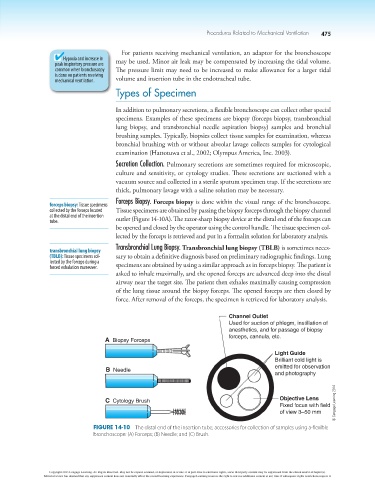
                                             Forceps Biopsy. Forceps biopsy is done within the visual range of the bronchoscope.
                        forceps biopsy: Tissue specimens
                        collected by the forceps located   Tissue specimens are obtained by passing the biopsy forceps through the biopsy channel
                        at the distal end of the insertion   outlet (Figure 14-10A). The razor-sharp biopsy device at the distal end of the forceps can
                        tube.
                                             be opened and closed by the operator using the control handle. The tissue specimen col-
                                             lected by the forceps is retrieved and put in a formalin solution for laboratory analysis.

                                             Transbronchial Lung Biopsy. Transbronchial lung biopsy (TBLB) is sometimes neces-
                        transbronchial lung biopsy
                        (TBLB): Tissue specimens col-  sary to obtain a definitive diagnosis based on preliminary radiographic findings. Lung
                        lected by the forceps during a   specimens are obtained by using a similar approach as in forceps biopsy. The patient is
                        forced exhalation maneuver.
                                             asked to inhale maximally, and the opened forceps are advanced deep into the distal
                                             airway near the target site. The patient then exhales maximally causing compression
                                             of the lung tissue around the biopsy forceps. The opened forceps are then closed by
                                             force. After removal of the forceps, the specimen is retrieved for laboratory analysis.


                                                                                  Channel Outlet
                                                                                  Used for suction of phlegm, instillation of
                                                                                  anesthetics, and for passage of biopsy
                                                                                  forceps, cannula, etc.
                                          A  Biopsy Forceps
                                                                                                 Light Guide
                                                                                                 Brilliant cold light is
                                                                                                 emitted for observation
                                          B  Needle
                                                                                                 and photography


                                          C  Cytology Brush                                        Objective Lens
                                                                                                   Fixed focus with field © Cengage Learning 2014
                                                                                                   of view 3–50 mm


                                      Figure 14-10  The distal end of the insertion tube; accessories for collection of samples using a-flexible
                                      bronchoscope: (A) Forceps; (B) Needle; and (C) Brush.


                        Copyright 2013 Cengage Learning. All Rights Reserved. May not be copied, scanned, or duplicated, in whole or in part. Due to electronic rights, some third party content may be suppressed from the eBook and/or eChapter(s).
                      Editorial review has deemed that any suppressed content does not materially affect the overall learning experience. Cengage Learning reserves the right to remove additional content at any time if subsequent rights restrictions require it.

