


Page 507 - Clinical Application of Mechanical Ventilation
P. 507
Procedures Related to Mechanical Ventilation  473


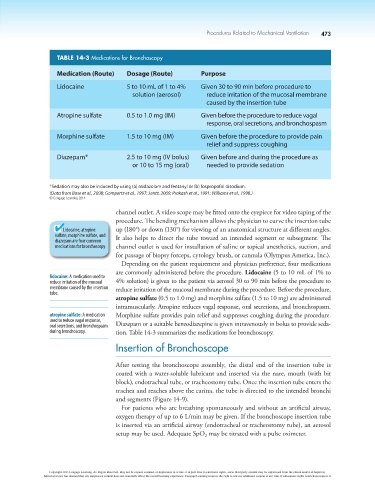
                          TABLE 14-3 Medications for Bronchoscopy

                          Medication (Route)     Dosage (Route)          Purpose

                          Lidocaine              5 to 10 mL of 1 to 4%   Given 30 to 90 min before procedure to
                                                   solution (aerosol)      reduce irritation of the mucosal membrane
                                                                           caused by the insertion tube

                          Atropine sulfate       0.5 to 1.0 mg (IM)      Given before the procedure to reduce vagal
                                                                           response, oral secretions, and bronchospasm

                          Morphine sulfate       1.5 to 10 mg (IM)       Given before the procedure to provide pain
                                                                           relief and suppress coughing
                          Diazepam*              2.5 to 10 mg (IV bolus)   Given before and during the procedure as
                                                   or 10 to 15 mg (oral)   needed to provide sedation


                        *Sedation may also be induced by using (a) midazolam and fentanyl or (b) fospropofol disodium.
                        (Data from Bose et al., 2008; Gompertz et al., 1997; Jantz, 2009; Prakash et al., 1991; Williams et al., 1998.)
                        © Cengage Learning 2014
                                             channel outlet. A video scope may be fitted onto the eyepiece for video taping of the
                                             procedure. The bending mechanism allows the physician to curve the insertion tube
                            Lidocaine, atropine   up (180°) or down (130°) for viewing of an anatomical structure at different angles.
                          sulfate, morphine sulfate, and   It also helps to direct the tube toward an intended segment or subsegment. The
                          diazepam are four common
                          medications for bronchoscopy.  channel outlet is used for installation of saline or topical anesthetics, suction, and
                                             for passage of biopsy forceps, cytology brush, or cannula (Olympus America, Inc.).
                                               Depending on the patient requirement and physician preference, four medications
                                             are commonly administered before the procedure. Lidocaine (5 to 10 mL of 1% to
                        lidocaine: A medication used to
                        reduce irritation of the mucosal   4% solution) is given to the patient via aerosol 30 to 90 min before the procedure to
                        membrane caused by the insertion   reduce irritation of the mucosal membrane during the procedure. Before the procedure,
                        tube.
                                             atropine sulfate (0.5 to 1.0 mg) and morphine sulfate (1.5 to 10 mg) are administered
                                             intramuscularly. Atropine reduces vagal response, oral secretions, and bronchospasm.
                        atropine sulfate: A medication   Morphine sulfate provides pain relief and suppresses coughing during the procedure.
                        used to reduce vagal response,
                        oral secretions, and bronchospasm   Diazepam or a suitable benzodiazepine is given intravenously in bolus to provide seda-
                        during bronchoscopy.  tion. Table 14-3 summarizes the medications for bronchoscopy.

                                             Insertion of Bronchoscope


                                             After testing the bronchoscope assembly, the distal end of the insertion tube is
                                             coated with a water-soluble lubricant and inserted via the nare, mouth (with bit
                                             block), endotracheal tube, or tracheostomy tube. Once the insertion tube enters the
                                             trachea and reaches above the carina, the tube is directed to the intended bronchi
                                             and segments (Figure 14-9).
                                               For patients who are breathing spontaneously and without an artificial airway,
                                             oxygen therapy of up to 6 L/min may be given. If the bronchoscope insertion tube
                                             is inserted via an artificial airway (endotracheal or tracheostomy tube), an aerosol
                                             setup may be used. Adequate SpO  may be titrated with a pulse oximeter.
                                                                          2


                        Copyright 2013 Cengage Learning. All Rights Reserved. May not be copied, scanned, or duplicated, in whole or in part. Due to electronic rights, some third party content may be suppressed from the eBook and/or eChapter(s).
                      Editorial review has deemed that any suppressed content does not materially affect the overall learning experience. Cengage Learning reserves the right to remove additional content at any time if subsequent rights restrictions require it.

