


Page 532 - Clinical Application of Mechanical Ventilation
P. 532
498    Chapter 15


                                            VAP range from 33 to 50%. The risk of VAP is highest immediately after intuba-
                          Risk factors for VAP   tion and initiation of mechanical ventilation. For the first 5 days, the incidence of
                        include long duration of me-
                        chanical ventilation, advanced   VAP is 3%. The rate decreases to 2% per day for the next 5 days, and 1% per day
                        age, depressed level of con-
                        sciousness, preexisting lung   thereafter. Patients who are admitted to the trauma, neurosurgical, or burn units
                        disease, immune suppression   have a higher incidence of VAP than those in the respiratory units and medical
                        due to disease or medications,
                        and malnutrition.   ICUs (Byrd et al., 2010; Cook et al., 1998; Craven, 2006).
                                             Risk factors for VAP include long duration of mechanical ventilation, advanced
                                            age, depressed level of consciousness, preexisting lung disease, immune suppression
                                            due to disease or medications, and malnutrition (Torpy et al., 2008).

                                            Clinical Presentations


                                            VAP is often associated with fever, leukocytosis or leukopenia, and purulent tra-
                          VAP is often associated   cheobronchial secretions. The radiographic signs of VAP include new or progressive
                        with fever, leukocytosis or
                        leukopenia, and purulent   infiltrates on chest radiography, The presence of lung infiltrates plus two of the
                        tracheobronchial secretions.  three criteria listed above had a sensitivity of 69% and a specificity of 75% for the
                                            diagnosis of VAP (Torres et al., 2004).
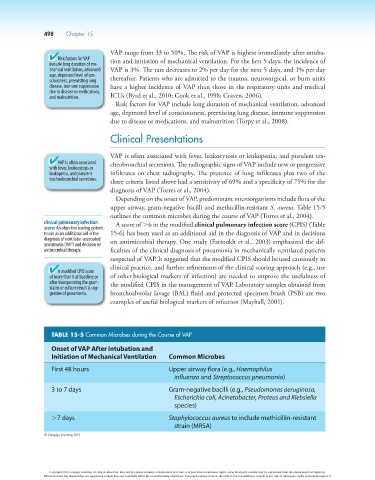
                                             Depending on the onset of VAP, predominant microorganisms include flora of the
                                            upper airway, gram-negative bacilli and methicillin-resistant S. aureus. Table 15-5
                                            outlines the common microbes during the course of VAP (Torres et al., 2004).
                      clinical pulmonary infection   A score of .6 in the modified clinical pulmonary infection score (CPIS) (Table
                      score: An objective scoring system
                      to use as an additional aid in the   15-6) has been used as an additional aid in the diagnosis of VAP and in decisions
                      diagnosis of ventilator-associated   on antimicrobial therapy. One study (Fartoukh et al., 2003) emphasized the dif-
                      pneumonia (VAP) and decision on

                      antimicrobial therapy.   ficulties of the clinical diagnosis of pneumonia in mechanically ventilated patients

                                            suspected of VAP. It suggested that the modified CPIS should be used cautiously in


                                            clinical practice, and further refinements of the clinical scoring approach (e.g., use
                          A modified CPIS score

                        of more than 6 at baseline or   of other biological markers of infection) are needed to improve the usefulness of
                        after incorporating the gram   the modified CPIS in the management of VAP. Laboratory samples obtained from
                        stains or culture result is sug-
                        gestive of pneumonia.  bronchoalveolar lavage (BAL) fluid and protected specimen brush (PSB) are two
                                            examples of useful biological markers of infection (Mayhall, 2001).


                        TABLE 15-5 Common microbes during the Course of VAP
                        Onset of VAP After Intubation and
                        Initiation of Mechanical Ventilation   Common Microbes

                        First 48 hours                         Upper airway flora (e.g., Haemophilus
                                                                 influenza and Streptococcus pneumonia)

                        3 to 7 days                            Gram-negative bacilli (e.g., Pseudomonas aeruginosa,
                                                                 Escherichia coli, Acinetobacter, Proteus and Klebsiella
                                                                 species)
                        .7 days                                Staphylococcus aureus to include methicillin-resistant
                                                                 strain (MRSA)
                      © Cengage Learning 2014


                        Copyright 2013 Cengage Learning. All Rights Reserved. May not be copied, scanned, or duplicated, in whole or in part. Due to electronic rights, some third party content may be suppressed from the eBook and/or eChapter(s).
                      Editorial review has deemed that any suppressed content does not materially affect the overall learning experience. Cengage Learning reserves the right to remove additional content at any time if subsequent rights restrictions require it.

