


Page 534 - Clinical Application of Mechanical Ventilation
P. 534
500    Chapter 15


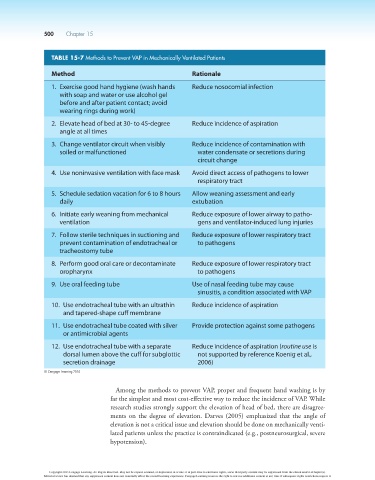
                        TABLE 15-7 methods to Prevent VAP in mechanically Ventilated Patients

                        Method                                        Rationale

                        1.   Exercise good hand hygiene (wash hands   Reduce nosocomial infection
                           with soap and water or use alcohol gel
                           before and after patient contact; avoid
                           wearing rings during work)
                        2.   Elevate head of bed at 30- to 45-degree   Reduce incidence of aspiration
                           angle at all times

                        3.   Change ventilator circuit when visibly   Reduce incidence of contamination with
                           soiled or malfunctioned                      water condensate or secretions during
                                                                        circuit change

                        4.   Use noninvasive ventilation with face mask  Avoid direct access of pathogens to lower
                                                                        respiratory tract

                        5.   Schedule sedation vacation for 6 to 8 hours   Allow weaning assessment and early
                           daily                                      extubation

                        6.   Initiate early weaning from mechanical   Reduce exposure of lower airway to patho-
                           ventilation                                  gens and ventilator-induced lung injuries
                        7.   Follow sterile techniques in suctioning and   Reduce exposure of lower respiratory tract
                           prevent contamination of endotracheal or     to pathogens
                           tracheostomy tube

                        8.   Perform good oral care or decontaminate   Reduce exposure of lower respiratory tract
                           oropharynx                                   to pathogens
                        9.  Use oral feeding tube                     Use of nasal feeding tube may cause
                                                                        sinusitis, a condition associated with VAP

                        10.   Use endotracheal tube with an ultrathin   Reduce incidence of aspiration
                            and tapered-shape cuff membrane

                        11.   Use endotracheal tube coated with silver   Provide protection against some pathogens
                            or antimicrobial agents

                        12.   Use endotracheal tube with a separate   Reduce incidence of aspiration (routine use is
                            dorsal lumen above the cuff for subglottic   not supported by reference Koenig et al.,
                            secretion drainage                          2006)
                      © Cengage Learning 2014


                                             Among the methods to prevent VAP, proper and frequent hand washing is by
                                            far the simplest and most cost-effective way to reduce the incidence of VAP. While
                                            research studies strongly support the elevation of head of bed, there are disagree-
                                            ments on the degree of elevation. Darves (2005) emphasized that the angle of
                                            elevation is not a critical issue and elevation should be done on mechanically venti-
                                            lated patients unless the practice is contraindicated (e.g., postneurosurgical, severe
                                            hypotension).


                        Copyright 2013 Cengage Learning. All Rights Reserved. May not be copied, scanned, or duplicated, in whole or in part. Due to electronic rights, some third party content may be suppressed from the eBook and/or eChapter(s).
                      Editorial review has deemed that any suppressed content does not materially affect the overall learning experience. Cengage Learning reserves the right to remove additional content at any time if subsequent rights restrictions require it.

