


Page 589 - Clinical Application of Mechanical Ventilation
P. 589
Neonatal Mechanical Ventilation  555


                                                                                                       © Cengage Learning 2014


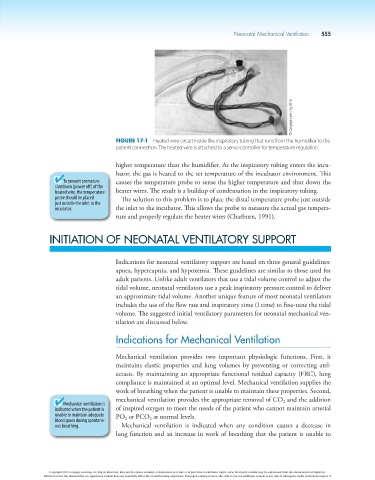
                                             Figure 17-1  Heated wire circuit inside the inspiratory tubing that runs from the humidifier to the
                                             patient connection. The heated wire is attached to a servo-controller for temperature regulation.

                                             higher temperature than the humidifier. As the inspiratory tubing enters the incu-
                                             bator, the gas is heated to the set temperature of the incubator environment. This
                            To prevent premature   causes the temperature probe to sense the higher temperature and shut down the
                          shutdown (power off) of the
                          heated wire, the temperature   heater wires. The result is a buildup of condensation in the inspiratory tubing.
                          probe should be placed   The solution to this problem is to place the distal temperature probe just outside
                          just outside the inlet to the
                          incubator.         the inlet to the incubator. This allows the probe to measure the actual gas tempera-
                                             ture and properly regulate the heater wires (Chatburn, 1991).


                        INITIATION OF NEONATAL VENTILATORY SUPPORT


                                             Indications for neonatal ventilatory support are based on three general guidelines:
                                             apnea, hypercapnia, and hypoxemia. These guidelines are similar to those used for
                                             adult patients. Unlike adult ventilators that use a tidal volume control to adjust the
                                             tidal volume, neonatal ventilators use a peak inspiratory pressure control to deliver
                                             an approximate tidal volume. Another unique feature of most neonatal ventilators
                                             includes the use of the flow rate and inspiratory time (I time) to fine-tune the tidal
                                             volume. The suggested initial ventilatory parameters for neonatal mechanical ven-
                                             tilation are discussed below.

                                             Indications for Mechanical Ventilation


                                             Mechanical  ventilation  provides  two  important  physiologic  functions.  First,  it
                                             maintains elastic  properties and  lung volumes by preventing or correcting atel-
                                             ectasis. By maintaining an appropriate functional residual capacity (FRC), lung
                                             compliance is maintained at an optimal level. Mechanical ventilation supplies the
                                             work of breathing when the patient is unable to maintain these properties. Second,
                                             mechanical ventilation provides the appropriate removal of CO  and the addition
                            Mechanical ventilation is                                               2
                          indicated when the patient is   of inspired oxygen to meet the needs of the patient who cannot maintain arterial
                          unable to maintain adequate   PO  or PCO  at normal levels.
                          blood gases during spontane-  2  2
                          ous breathing.       Mechanical  ventilation  is  indicated  when  any  condition  causes  a  decrease  in
                                             lung function and an increase in work of breathing that the patient is unable to


                        Copyright 2013 Cengage Learning. All Rights Reserved. May not be copied, scanned, or duplicated, in whole or in part. Due to electronic rights, some third party content may be suppressed from the eBook and/or eChapter(s).
                      Editorial review has deemed that any suppressed content does not materially affect the overall learning experience. Cengage Learning reserves the right to remove additional content at any time if subsequent rights restrictions require it.

