


Page 593 - Clinical Application of Mechanical Ventilation
P. 593
Neonatal Mechanical Ventilation  559


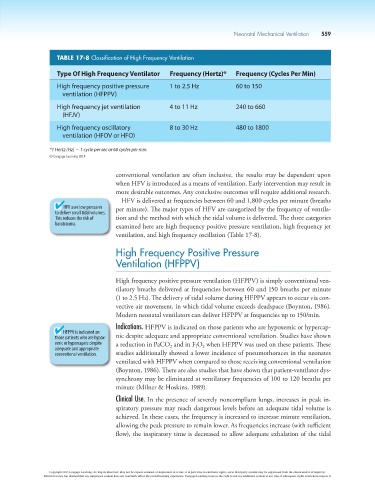
                          TABLE 17-8 Classification of High Frequency Ventilation

                          Type Of High Frequency Ventilator    Frequency (Hertz)*    Frequency (Cycles Per Min)

                          High frequency positive pressure     1 to 2.5 Hz           60 to 150
                            ventilation (HFPPV)

                          High frequency jet ventilation       4 to 11 Hz            240 to 660
                            (HFJV)
                          High frequency oscillatory           8 to 30 Hz            480 to 1800
                            ventilation (HFOV or HFO)

                        *1	Hertz	(Hz)	5	1	cycle	per	sec	or	60	cycles	per	min.
                        © Cengage Learning 2014

                                             conventional ventilation are often inclusive, the results may be dependent upon
                                             when HFV is introduced as a means of ventilation. Early intervention may result in
                                             more desirable outcomes. Any conclusive outcomes will require additional research.
                                               HFV is delivered at frequencies between 60 and 1,800 cycles per minute (breaths
                            HFV uses low pressures   per minute). The major types of HFV are categorized by the frequency of ventila-
                          to deliver small tidal volumes.
                          This reduces the risk of   tion and the method with which the tidal volume is delivered. The three categories
                          barotrauma.        examined here are high frequency positive pressure ventilation, high frequency jet
                                             ventilation, and high frequency oscillation (Table 17-8).

                                             High Frequency Positive Pressure
                                             Ventilation (HFPPV)


                                             High frequency positive pressure ventilation (HFPPV) is simply conventional ven-
                                             tilatory breaths delivered at frequencies between 60 and 150 breaths per minute
                                             (1 to 2.5 Hz). The delivery of tidal volume during HFPPV appears to occur via con-
                                             vective air movement, in which tidal volume exceeds deadspace (Boynton, 1986).
                                             Modern neonatal ventilators can deliver HFPPV at frequencies up to 150/min.
                                             Indications. HFPPV is indicated on those patients who are hypoxemic or hypercap-
                            HFPPV is indicated on
                          those patients who are hypox-  nic despite adequate and appropriate conventional ventilation. Studies have shown
                          emic or hypercapnic despite   a reduction in PaCO  and in F O  when HFPPV was used on these patients. These
                          adequate and appropriate             2       I  2
                          conventional ventilation.  studies additionally showed a lower incidence of pneumothoraces in the neonates
                                             ventilated with HFPPV when compared to those receiving conventional ventilation
                                             (Boynton, 1986). There are also studies that have shown that patient-ventilator dys-
                                             synchrony may be eliminated at ventilatory frequencies of 100 to 120 breaths per
                                             minute (Milner & Hoskins, 1989).

                                             Clinical Use. In the presence of severely noncompliant lungs, increases in peak in-
                                             spiratory pressure may reach dangerous levels before an adequate tidal volume is
                                             achieved. In these cases, the frequency is increased to increase minute ventilation,
                                             allowing the peak pressure to remain lower. As frequencies increase (with sufficient
                                             flow), the inspiratory time is decreased to allow adequate exhalation of the tidal


                        Copyright 2013 Cengage Learning. All Rights Reserved. May not be copied, scanned, or duplicated, in whole or in part. Due to electronic rights, some third party content may be suppressed from the eBook and/or eChapter(s).
                      Editorial review has deemed that any suppressed content does not materially affect the overall learning experience. Cengage Learning reserves the right to remove additional content at any time if subsequent rights restrictions require it.

