


Page 73 - Clinical Application of Mechanical Ventilation
P. 73
Effects of Positive Pressure Ventilation  39


                        ABDOMINAL CONSIDERATIONS


                                             Increases  in  intra-abdominal  pressure  (IAP)  are  related  to  clinical  conditions
                        intra-abdominal pressure
                        (IAP): Pressure measured by a   such as bowel edema or obstruction and ascites. IAP may also be increased in pro-
                        transducer via a transurethral   cedures such as use of pneumatic antishock garments and surgical repair of ab-
                        bladder catheter.
                                             dominal wall hernias. When these patients are placed on mechanical ventilation,
                                             conditions that are conducive to an increase in IAP should be monitored to avert
                                             potential complications.


                                             Effects of PEEP and Increased
                                             Intra-Abdominal Pressure


                                             An elevated IAP transmits excessive pressure across the diaphragm to the heart and
                            Elevated intra-abdominal   great vessels. In turn, this excessive pressure leads to decreased cardiac output (Cullen
                          pressure transmits excessive
                          pressure across the diaphragm   et al., 1989) and decreased renal perfusion (Harman et al., 1982). Excessive IAP
                          to the heart and great vessels.   also compresses the lungs and reduces the functional residual capacity (Burchard
                          In turn, this excess pressure
                          leads to decreased cardiac   et al., 1985). It has been shown that use of PEEP on patients with elevated IAP
                          output and decreased renal
                          perfusion.         may lead to cardiovascular, renal, and pulmonary dysfunction (Burchard et al., 1985;
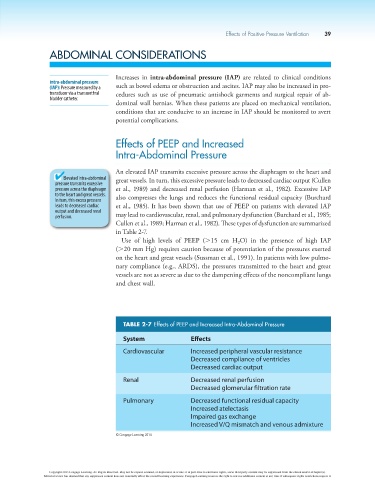
                                             Cullen et al., 1989; Harman et al., 1982). These types of dysfunction are summarized
                                             in Table 2-7.
                                               Use  of  high  levels  of  PEEP  (.15  cm  H O)  in  the  presence  of  high  IAP
                                                                                     2
                                             (.20 mm Hg) requires caution because of potentiation of the pressures exerted
                                             on the heart and great vessels (Sussman et al., 1991). In patients with low pulmo-
                                             nary compliance (e.g., ARDS), the pressures transmitted to the heart and great
                                             vessels are not as severe as due to the dampening effects of the noncompliant lungs
                                             and chest wall.


                                                TABLE 2-7 Effects of PEEP and Increased Intra-Abdominal Pressure
                                                System                Effects

                                                Cardiovascular        Increased peripheral vascular resistance
                                                                      Decreased compliance of ventricles
                                                                      Decreased cardiac output

                                                Renal                 Decreased renal perfusion
                                                                      Decreased glomerular filtration rate

                                                Pulmonary             Decreased functional residual capacity
                                                                      Increased atelectasis
                                                                      Impaired gas exchange
                                                                      Increased V/Q mismatch and venous admixture
                                             © Cengage Learning 2014


                        Copyright 2013 Cengage Learning. All Rights Reserved. May not be copied, scanned, or duplicated, in whole or in part. Due to electronic rights, some third party content may be suppressed from the eBook and/or eChapter(s).
                      Editorial review has deemed that any suppressed content does not materially affect the overall learning experience. Cengage Learning reserves the right to remove additional content at any time if subsequent rights restrictions require it.

