


Page 92 - Clinical Application of Mechanical Ventilation
P. 92
58     Chapter 3


                                               The ventilator is a     The ventilator is a      The ventilator is a
                                                 Pressure                  Time                    Volume
                                                 Controller              Controller               Controller

                                                      no                      yes                      yes
                                Observation  Does pressure waveform  Does volume waveform    Is volume measured directly
                                   and        change when patient  yes  change when patient  no  (by volumetric displacement
                                 previous   resistance and compliance  resistance and compliance  rather than by flow From R. L. Chatburn (1991). Respir Care, 36(10). Used with permission.
                                knowledge         change?                 change?                 transducer)?
                                                                                                       no

                                                                                                The ventilator is a
                                                                                                    Flow
                                                                                                  Controller
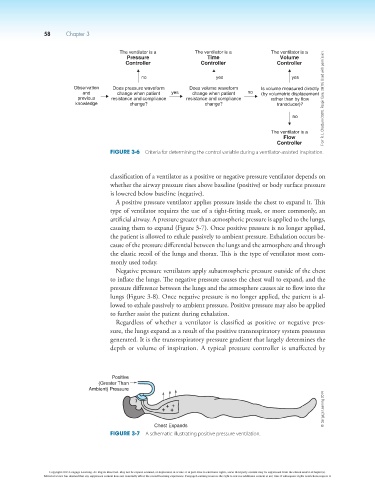
                                            Figure 3-6  Criteria for determining the control variable during a ventilator-assisted inspiration.


                                            classification of a ventilator as a positive or negative pressure ventilator depends on
                                            whether the airway pressure rises above baseline (positive) or body surface pressure
                                            is lowered below baseline (negative).
                                             A positive pressure ventilator applies pressure inside the chest to expand it. This
                                            type of ventilator requires the use of a tight-fitting mask, or more commonly, an
                                            artificial airway. A pressure greater than atmospheric pressure is applied to the lungs,
                                            causing them to expand (Figure 3-7). Once positive pressure is no longer applied,
                                            the patient is allowed to exhale passively to ambient pressure. Exhalation occurs be-
                                            cause of the pressure differential between the lungs and the atmosphere and through
                                            the elastic recoil of the lungs and thorax. This is the type of ventilator most com-
                                            monly used today.
                                             Negative pressure ventilators apply subatmospheric pressure outside of the chest
                                            to inflate the lungs. The negative pressure causes the chest wall to expand, and the
                                            pressure difference between the lungs and the atmosphere causes air to flow into the
                                            lungs (Figure 3-8). Once negative pressure is no longer applied, the patient is al-
                                            lowed to exhale passively to ambient pressure. Positive pressure may also be applied
                                            to further assist the patient during exhalation.
                                             Regardless  of  whether  a  ventilator  is  classified  as  positive  or  negative  pres-
                                            sure, the lungs expand as a result of the positive transrespiratory system pressures
                                            generated. It is the transrespiratory pressure gradient that largely determines the
                                            depth or volume of inspiration. A typical pressure controller is unaffected by


                                            Positive
                                        (Greater Than
                                     Ambient) Pressure
                                                                                                                 © Cengage Learning 2014


                                                          Chest Expands
                                            Figure 3-7  A schematic illustrating positive pressure ventilation.


                        Copyright 2013 Cengage Learning. All Rights Reserved. May not be copied, scanned, or duplicated, in whole or in part. Due to electronic rights, some third party content may be suppressed from the eBook and/or eChapter(s).
                      Editorial review has deemed that any suppressed content does not materially affect the overall learning experience. Cengage Learning reserves the right to remove additional content at any time if subsequent rights restrictions require it.

