


Page 93 - Clinical Application of Mechanical Ventilation
P. 93
Classification of Mechanical Ventilators  59


                                              Ambient Pressure


                                                                                                                   © Cengage Learning 2014


                                                                                  Subambient
                                                           Chest Expands           Pressure

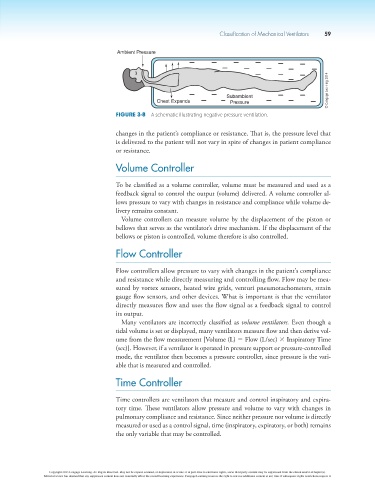
                                             Figure 3-8  A schematic illustrating negative pressure ventilation.

                                             changes in the patient’s compliance or resistance. That is, the pressure level that
                                             is delivered to the patient will not vary in spite of changes in patient compliance
                                             or resistance.

                                             Volume Controller


                                             To be classified as a volume controller, volume must be measured and used as a
                                             feedback signal to control the output (volume) delivered. A volume controller al-
                                             lows pressure to vary with changes in resistance and compliance while volume de-
                                             livery remains constant.
                                               Volume controllers can measure volume by the displacement of the piston or
                                             bellows that serves as the ventilator’s drive mechanism. If the displacement of the
                                             bellows or piston is controlled, volume therefore is also controlled.
                                             Flow Controller


                                             Flow controllers allow pressure to vary with changes in the patient’s compliance
                                             and resistance while directly measuring and controlling flow. Flow may be mea-
                                             sured by vortex sensors, heated wire grids, venturi pneumotachometers, strain
                                             gauge flow sensors, and other devices. What is important is that the ventilator
                                             directly measures flow and uses the flow signal as a feedback signal to control
                                             its output.
                                               Many ventilators are incorrectly classified as volume ventilators. Even though a
                                             tidal volume is set or displayed, many ventilators measure flow and then derive vol-
                                             ume from the flow measurement [Volume (L) 5 Flow (L/sec) 3 Inspiratory Time
                                             (sec)]. However, if a ventilator is operated in pressure support or pressure-controlled
                                             mode, the ventilator then becomes a pressure controller, since pressure is the vari-
                                             able that is measured and controlled.

                                             Time Controller


                                             Time controllers are ventilators that measure and control inspiratory and expira-
                                             tory time. These ventilators allow pressure and volume to vary with changes in
                                             pulmonary compliance and resistance. Since neither pressure nor volume is directly
                                             measured or used as a control signal, time (inspiratory, expiratory, or both) remains
                                             the only variable that may be controlled.


                        Copyright 2013 Cengage Learning. All Rights Reserved. May not be copied, scanned, or duplicated, in whole or in part. Due to electronic rights, some third party content may be suppressed from the eBook and/or eChapter(s).
                      Editorial review has deemed that any suppressed content does not materially affect the overall learning experience. Cengage Learning reserves the right to remove additional content at any time if subsequent rights restrictions require it.

