


Page 105 - Cardiac Nursing
P. 105
1 A
                                             M
                       9-0
                           qxd
                         96.
                                        8:4
                                               P
                                                    1 A
                                                       pta
                                                         ra
                                                 g
                                                  e 8
                    p06
               0-c
                 03_
                                  9/2
            K34
         LWB K34 0-c 03_ p06 9-0 96. qxd  0 9/0 9/2 009  0 0 8:4 1 A M  P a a g e 8 1 A pta ra
         L L LWB
         LWBK340-c03_p069-096.qxd  09/09/2009  08:41 AM  Page 81 Aptara
                                9/0
                               0
                                    009
                                                          C HAPTER  3 / Regulation of Cardiac Output and Blood Pressure  81
                            200                                        reflex is caused by pulmonary hyperventilation, which leads to
                                                                       hypocapnia and activation of pulmonary stretch receptors. The
                                                                       chemosensor reflex plays only a minimal role in the control of
                           Δ R-R interval, (msec) 130                  eral chemosensor responses may contribute to sympathetic over-
                                                                       heart rate because the primary and secondary reflexes tend to off-
                                                                                  36
                                                                                    In heart failure, abnormal central and periph-
                                                                       set one another.
                             60
                                                                                                           164,165
                                                                       activity and suppression of baroreceptor function.
                            –10
                            –80                                        Respiratory Sinus Arrhythmia
                                                                       There is a direct relation between heart rate and respiration. Dur-
                                                                       ing inspiration the heart rate increases, then it decreases during ex-
                                                                       piration. This respiratory-induced cyclical variation in heart rate is
                           –150
                                                                       referred to as a respiratory sinus arrhythmia. There is an ongoing
                                50    90    130    170   210
                                                                       debate whether this arrhythmia is due to a central mechanism, a
                                Carotid distending pressure, (mm/Hg)                              166
                                                                       baroreflex, or a combination of both.  The effector arm of this
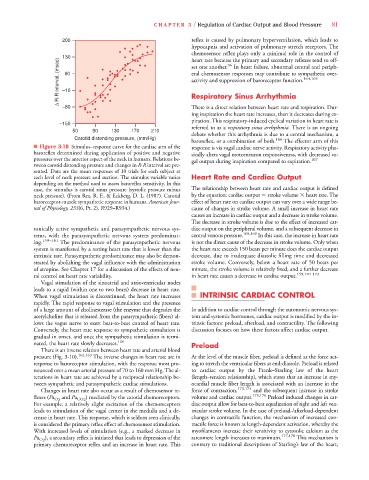
                   ■ Figure 3-10 Stimulus–response curve for the cardiac arm of the  response is via vagal cardiac nerve activity. Respiratory activity pha-
                   baroreflex determined during application of positive and negative  sically alters vagal motorneuron responsiveness, with decreased va-
                   pressures over the anterior aspect of the neck in humans. Relations be-  gal output during inspiration compared to expiration. 167
                   tween carotid distending pressure and changes in R-R interval are pre-
                                                     R
                                                     R
                   sented. Data are the mean responses of 10 trials for each subject at
                   each level of neck pressure and suction. The stimulus variable varies  Heart Rate and Cardiac Output
                   depending on the method used to assess baroreflex sensitivity. In this
                   case, the stimulus is carotid sinus pressure (systolic pressure minus  The relationship between heart rate and cardiac output is defined
                   neck pressure). (From Rea, R. F., & Eckberg, D. L. (1987). Carotid  by the equation: cardiac output   stroke volume   heart rate. The
                   baroreceptor-muscle sympathetic response in humans. American Jour-  effect of heart rate on cardiac output can vary over a wide range be-
                   nal of Physiology, 253(6, Pt. 2), R929–R934.)       cause of changes in stroke volume. A small increase in heart rate
                                                                       causes an increase in cardiac output and a decrease in stroke volume.
                                                                       The decrease in stroke volume is due to the effect of increased car-
                   tonically active sympathetic and parasympathetic nervous sys-  diac output on the peripheral volume, and a subsequent decrease in
                   tems, with the parasympathetic nervous system predominat-  central venous pressure. 168,169  In this case, the increase in heart rate
                   ing.  159–161  The predominance of the parasympathetic nervous  is not the direct cause of the decrease in stroke volume. Only when
                   system is manifested by a resting heart rate that is lower than the  the heart rate exceeds 150 beats per minute does the cardiac output
                   intrinsic rate. Parasympathetic predominance may also be demon-  decrease, due to inadequate diastolic filling time and decreased
                   strated by abolishing the vagal influence with the administration  stroke volume. Conversely, below a heart rate of 50 beats per
                   of atropine. See Chapter 17 for a discussion of the effects of neu-  minute, the stroke volume is relatively fixed, and a further decrease
                   ral control on heart rate variability.              in heart rate causes a decrease in cardiac output. 159,170–172
                     Vagal stimulation of the sinoatrial and atrioventricular nodes
                   leads to a rapid (within one to two beats) decrease in heart rate.
                   When vagal stimulation is discontinued, the heart rate increases  INTRINSIC CARDIAC CONTROL
                   rapidly. The rapid response to vagal stimulation and the presence
                   of a large amount of cholinesterase (the enzyme that degrades the  In addition to cardiac control through the autonomic nervous sys-
                   acetylcholine that is released from the parasympathetic fibers) al-  tem and systemic hormones, cardiac output is modified by the in-
                   lows the vagus nerve to exert beat-to-beat control of heart rate.  trinsic factors: preload, afterload, and contractility. The following
                   Conversely, the heart rate response to sympathetic stimulation is  discussion focuses on how these factors affect cardiac output.
                   gradual in onset, and once the sympathetic stimulation is termi-
                   nated, the heart rate slowly decreases. 160         Preload
                     There is an inverse relation between heart rate and arterial blood
                   pressure (Fig. 3-10). 162,163  The inverse changes in heart rate are in  At the level of the muscle fiber, preload is defined as the force act-
                   response to baroreceptor stimulation, with the response most pro-  ing to stretch the ventricular fibers at end-diastole. Preload is related
                   nounced over a mean arterial pressure of 70 to 160 mm Hg. The al-  to cardiac output by the Frank–Starling law of the heart
                   terations in heart rate are achieved by a reciprocal relationship be-  (length–tension relationship), which states that an increase in my-
                   tween sympathetic and parasympathetic cardiac stimulations.  ocardial muscle fiber length is associated with an increase in the
                     Changes in heart rate also occur as a result of chemosensor re-  force of contraction, 173,174  and the subsequent increase in stroke
                        P      P    ) mediated by the carotid chemoreceptors.  volume and cardiac output. 175,176  Preload induced changes in car-
                        P
                               P
                   flexes (Pa O 2  and Pa CO 2
                   For example, a relatively slight excitation of the chemoreceptors  diac output allow for beat-to-beat equalization of right and left ven-
                   leads to stimulation of the vagal center in the medulla and a de-  tricular stroke volume. In the case of preload-/afterload-dependent
                   crease in heart rate. This response, which is seldom seen clinically,  changes in contractile function, the mechanism of increased con-
                   is considered the primary reflex effect of chemosensor stimulation.  tractile force is known as length-dependent activation, whereby the
                   With increased levels of stimulation (e.g., a marked decrease in  myofilaments increase their sensitivity to cytosolic calcium as the
                       ), a secondary reflex is initiated that leads to depression of the  sarcomere length increases to maximum. 177,178  This mechanism is
                   Pa P P O 2
                   primary chemoreceptor reflex and an increase in heart rate. This  contrary to traditional descriptions of Starling’s law of the heart,

